A major exhibition of Chinese horse paintings jointly organised by the Hong Kong Palace Museum and the Palace Museum and exclusively sponsored by the Institute of Philanthropy
The Hong Kong Palace Museum (HKPM or the Museum) is pleased to present a new thematic exhibition, “Heavenly Horses: Masterpieces from the Palace Museum” (“Heavenly Horses”), on view from 20 March 2026 through 17 March 2027. “Heavenly Horses” will be the HKPM’s first exhibition in 2026, the Year of the Horse, and the city’s first large-scale exhibition dedicated to Chinese classical horse paintings across dynasties. It is one of the new exhibitions presented by the West Kowloon Cultural District (WestK) during “Art March Hong Kong”. The exhibition is jointly organised by the HKPM and the Palace Museum, exclusively sponsored by the Institute of Philanthropy (IoP) and is one of the highlights in The Hong Kong Jockey Club’s Year of the Horse campaign.
“Heavenly Horses” features nearly 100 masterpieces by over 60 renowned artists, spanning from the Yuan dynasty (1271–1368) to the 20th century, presented in four rotations. Among these works are 76 exquisite paintings from the Palace Museum, including 15 grade-one national treasures. The exhibition also includes significant loans from the Hong Kong Museum of Art and the Art Museum, The Chinese University of Hong Kong. “Heavenly Horses” celebrates the significance of horses in Chinese art, fostering dialogue between courtly and literati renderings of horses, classical and modern styles, and Chinese and European painting traditions. Visitors will gain profound insights into the unique artistic and cultural significance of horse paintings in China.
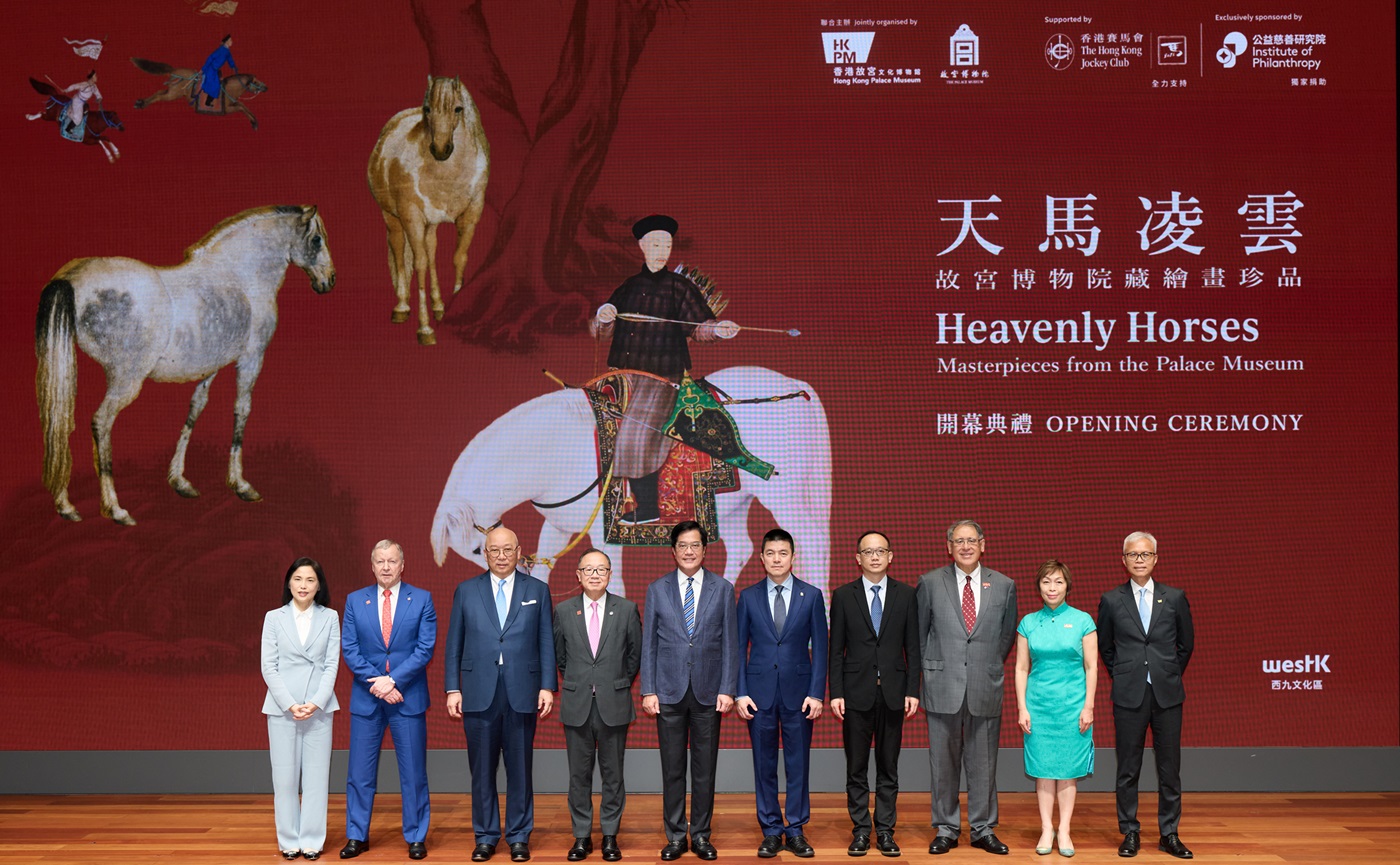
The opening ceremony was held today at the HKPM, attended by Michael Wong, Deputy Financial Secretary of the Government of the Hong Kong Special Administrative Region (HKSAR); Lin Zhan, Deputy Director-General of the Department of Publicity, Cultural and Sports Affairs of the Liaison Office of the Central People’s Government in the HKSAR; Lou Wei, Executive Deputy Director of the Palace Museum; Martin Liao, Chairman of The Hong Kong Jockey Club; Lester Huang, Deputy Chairman of The Hong Kong Jockey Club and IoP Chairman; Ann Kung, Trustee of The Hong Kong Jockey Club Charities Trust and IoP Deputy Chairman; Winfried Engelbrecht-Bresges, Chief Executive Officer of The Hong Kong Jockey Club and IoP Director; Leo Kung, Chairman of the HKPM Board; Betty Fung, Chief Executive Officer of the West Kowloon Cultural District Authority; and Dr Louis Ng, Museum Director of the HKPM.
Michael Wong, Deputy Financial Secretary of the Government of the HKSAR, expressed his gratitude to the Hong Kong Palace Museum and the Palace Museum for jointly organising this exhibition, which brings nearly one hundred precious equine paintings to Hong Kong. He said, “Since its opening in 2022, the Hong Kong Palace Museum has greatly contributed to promoting cultural torusim in Hong Kong, staging more than thirty exhibitions and welcomed over four million visitors to date. The museum has become a must‑visit destination for many tourists to Hong Kong, and has exerted tremendous international influence in telling the good stories of Hong Kong and China, and further promoting Chinese culture.”
Lou Wei, Executive Deputy Director of the Palace Museum, said, “The Palace Museum has long maintained a close partnership with the Hong Kong Palace Museum, collaborating to showcase the finest of Chinese art and culture to both local and international audiences, and to promote cultural exchange and mutual understanding. This exhibition forms an integral part of a five-year collaboration between the Palace Museum and the Institute of Philanthropy, which aims to promote Chinese culture and nurture arts-technology talent. Horses were not only a vital means of travel in ancient times and representations of ceremonial standards; they also served as the foundation of national defence. They stand as a vivid symbol of the Chinese nation’s resilience and unwavering spirit. With a focus on equine motifs, ‘Heavenly Horses’ guides visitors to explore the artistic vision of renowned masters and uncovers the social landscapes, spiritual aspiration, and cultural exchanges of different eras, offering a deeper understanding of the profound richness and refined subtleties of Chinese civilisation.”
Leo Kung, Chairman of the HKPM Board, said, “Coinciding with the Year of the Horse, the Hong Kong Palace Museum presents the ‘Heavenly Horses’, bringing together equine masterpieces by celebrated artists across dynasties, offering a most fitting celebration of the occasion. Through the curatorial process, the team has made new discoveries and developed fresh insights. We eagerly look forward to sharing these treasures and the stories they hold with visitors from near and far, allowing a conversation that bridges past and present to unfold at the Hong Kong Palace Museum.”
Martin Liao, Chairman of The Hong Kong Jockey Club, said, “The Hong Kong Jockey Club and its Charities Trust established the Institute of Philanthropy as an independent ‘think-fund-do’ tank for China, Asia and beyond. In 2024, IoP announced a donation of RMB 371 million to launch a five-year collaboration programme with the Palace Museum to promote the excellence of traditional Chinese culture, and to deepen understanding and recognition of Chinese history and culture among younger generations in Hong Kong and the Chinese Mainland. This exhibition is a key component of the programme and one of the highlights of The Hong Kong Jockey Club’s Year of the Horse campaign. Featuring a variety of cultural, arts and community initiatives throughout the year, we aim to spread joyful celebration across the city, promote tourism and advance the development of sports, including horse sports.”
The distinctive achievements and rich meanings of Chinese horse painting
The horse──which symbolises resilience, vigour, loyalty, and nobility──has long been a cherished subject of Chinese painting. In ancient times, horses not only carried goods and information across vast distances but also served as loyal companions for those undertaking long journeys. Humans have deep emotional connections to horses and still prize them today.
Divided into four thematic sections, “Heavenly Horses” showcases the artistic achievement of Chinese horse painting. The first section, “The Court: Horseback Travels and Mounted Archery”, presents works by court painters depicting scenes of imperial excursions and historical anecdotes. The second section, “The Frontiers: Hooves in the Dust”, focuses on paintings set in the borderlands. Among the subjects are tribute processions, marriage alliances, and battle paintings created by Qing (1644–1911) court painters. The third section, “Landscapes of Mind and Steed”, tells tales of literati with horses as their travel companions in landscape paintings that highlight the innovative approaches of the Ming (1368–1644) and Qing painters in figure-and-horse composition. The final section, “East and West: Steeds Across Time”, features an array of works from the late Qing dynasty to the modern era, illustrating influences from Europe and beyond on Chinese painters’ new approaches to horse painting.
A once-in-a-lifetime opportunity to see national painting treasures
The exhibition will unfold in four rotations*, each with approximately 20 works on display. To preserve the light-sensitive works on paper or silk, most exhibits will be on view for three months. The exhibition brings together works by such pre-eminent artists as Qiu Ying (about 1494–1552), one of the “Four Masters of the Ming dynasty”; Qing court painter and Italian Jesuit missionary Giuseppe Castiglione (1688–1766); the Shanghai School master Ren Yi (1840–1896); and Xu Beihong (1895–1953), internationally celebrated for his horse paintings. These masters with their distinctive techniques and styles have captured the form, spirit, and movement of horses, revealing the rich symbolism of the horse across cultural and historical contexts.
A notable example of rare Yuan-dynasty horse paintings is Three Horses by Jiufeng Daoren (active in the 14th century), which depicts foreign envoys presenting tribute horses. This handscroll, a grade-one national treasure, will be displayed for only a month, from 20 March to 16 April 2026, and will return to the warehouse for a rest period for conservation purposes. According to the History of the Yuan Dynasty, the Kingdom of Folang (a term referring to parts of present-day Europe) offered a prized horse as tribute to the Shundi Emperor (r. 1333–1368) in the seventh lunar month of 1342, which suggests that the creation of this painting might be related to this event. In creating a work for the imperial court, the artist skillfully combined historical elements and imagination.
Cultural exchange and literati expression in horse painting
Large‑format court paintings will also be featured in “Heavenly Horses”. In some of these works, the horses and figures were first rendered by European painters, and then Chinese artists painted the landscape backgrounds. These collaborative works not only establish powerful images of valiant Qing emperors but also reflect the exchange of painting techniques between Chinese and European artists. A classic example is The Qianlong Emperor Holding an Arrow, created by Giuseppe Castiglione and his Chinese collaborators. This imposing work, which stands 2.59 metres in height, depicts the Qianlong Emperor (r. 1736–1795), then in his thirties, sitting astride his majestic white horse named “Jade Lion”.
In addition to court paintings, landscape paintings, and portraits, the exhibition features rare works making their first appearance outside the Palace Museum, including Horse by Prince Aisin‑Gioro Zaiying (1859–1930), the grandson of the Daoguang Emperor (r. 1821–1850). A representative of the celebrated tradition of saddled-horse painting, Zaiying drew a solitary white steed, rendered in ink against a starkly blank background, a contrast that accentuates the luminous delicacy of its white coat and its noble, virtuous spirit. Here and in Zaiying’s later works, the artist masterfully integrates Chinese brushwork techniques with European anatomy and sketch-like expressiveness.
One of the masterpieces of literati horse painting, Landscape by the Ming painter Wen Jia (1501–1583) depicts a scholar riding a white horse across a bridge, enveloped by swirling clouds and mist. The painting echoes the renowned verses of the famous Tang dynasty (618–907) poet Li Bai (701–762): “Above the man’s face arise the hills; Beside the horse’s head emerge the clouds”. In the 17th century, during the late Ming and early Qing dynasties, Zhang Mu (1607–1683), active in the Lingnan region of southern China, emerged as one of the few distinguished masters of horse painting. He excelled at capturing the physique, demeanour, and personality of individual horses. In Horse Under a Tree, a poignant depiction of a solitary horse bound to a tree, he evokes a powerful sense of introspection.
AI-powered horse paintings and Hong Kong’s horse stories
The exhibition features a variety of creative arts-tech interactive experiences and educational activities. One highlight is the launch of the HKPM’s first AI-powered installation inside the galleries, inviting visitors to use three painters──Edgar Degas, Xu Beihong, and Giuseppe Castiglione──as inspiration and create their own horse paintings in Chinese and European styles. They can also explore horses in Chinese poetry as well as painting, along with place names and stories related to horses in Hong Kong. Guided tours, talks by experts, and painting workshops will provide visitors with a deeper understanding of Chinese painting and horse culture.
The Museum’s gift shop, ART EXPRESS by The Commercial Press, has introduced over 30 horse-inspired items, from sachets and bracelets to cushions, shawls, scarves, and socks, blending traditional motifs with modern style. A standout item is a decorative print featuring a silver-foil effect, illustrating two horses galloping side by side. This design is adapted from Xu Beihong’s wedding-gift painting, Two Horses, which is on display during the first rotation of the exhibition. Throughout the exhibition period, the HKPM will also release horse-themed cultural products, allowing visitors to take home the vitality and artistic charm of the horse.
“Heavenly Horses: Masterpieces from the Palace Museum” will open to the public from 20 March 2026 in Gallery 4 of the HKPM. Visitors can access this exhibition with a General Admission ticket (Galleries 1 to 7; priced at HK$70 for adults and HK$35 for concessions#) or a Special Exhibition ticket. Tickets are available for sale or reservation via the HKPM website, the WestK website or mobile app, the WestK ticketing’s WeChat mini programme, and the online platforms of the Museum’s ticketing partners.
*Remarks: Rotation Period of “Heavenly Horses: Masterpieces from the Palace Museum”
Rotation 1: 20 Mar 2026 to 15 Jun 2026
Rotation 2: 17 Jun 2026 to 14 Sep 2026
Rotation 3: 16 Sep 2026 to 14 Dec 2026
Rotation 4: 16 Dec 2026 to 17 Mar 2027
#Concessions are available to children aged 7 to 11, full-time students, seniors aged 60 and above, persons with disabilities (with one companion), and CSSA recipients. Children aged 6 and below do not need a ticket.
Remarks
About the Hong Kong Palace Museum
The Hong Kong Palace Museum aspires to become a leading institution on the study and appreciation of Chinese art and culture while advancing dialogue between world civilisations. The Hong Kong Palace Museum is a collaborative project between the West Kowloon Cultural District Authority and the Palace Museum and is funded by The Hong Kong Jockey Club Charities Trust with a donation of HK$3.5 billion for its establishment, as well as some of the annual exhibitions and education programmes in 2023–2031.
Embracing new curatorial approaches, the Museum combines a Hong Kong perspective with a global vision to present precious artefacts from the Palace Museum and other important cultural institutions around the world. Through research, exhibitions, and educational and professional exchange programmes, the Museum aims to build international partnerships and position Hong Kong as a global hub for art and culture. At heart a resource that belongs to the local community, the Museum strives to inspire community engagement, foster dialogue, and promote creativity and interdisciplinary collaboration.
About the Palace Museum
Established in 1925, the Palace Museum is a comprehensive museum built on the foundations of the Ming and Qing imperial palaces, the Forbidden City, integrating architecture, cultural relics, and the rich historical and cultural heritage of the imperial courts. In 1961, the State Council listed it as one of the first batch of “Major National Cultural Heritage Sites”, and in 1987, it was designated a World Heritage Site by UNESCO. The Palace Museum became a National 5A Tourist Attraction in 2007. The following year, it was among the first Chinese museums recognised by the National Cultural Heritage Administration as a “National First-level Museum”. The Palace Museum spans a total area of 106 hectares and has a total construction area of 233,300 square metres, making it the world’s largest and best-preserved historical palatial complex.
Today, the Palace Museum is an unparalleled art treasure house with a vast collection of over 1.95 million items/sets in twenty-five major categories. It showcases the time-honoured and splendid Chinese civilisation to the public through its imperial palace architecture; the display of original interior settings to illustrate the history of the imperial court; galleries dedicated to decorative arts, timepieces, paintings, calligraphic works, ceramics, and sculptures; and thematic exhibitions.
About the West Kowloon Cultural District (WestK)
WestK is one of the largest and most ambitious cultural projects in the world. Its vision is to create a vibrant new cultural quarter for Hong Kong on 40 hectares of reclaimed land located alongside Victoria Harbour. With a varied mix of theatres, performance spaces, and museums, WestK will produce and host world-class exhibitions, performances, and cultural events, providing 23 hectares of public open space, including a two-kilometre waterfront promenade.
https://www.westk.hk/