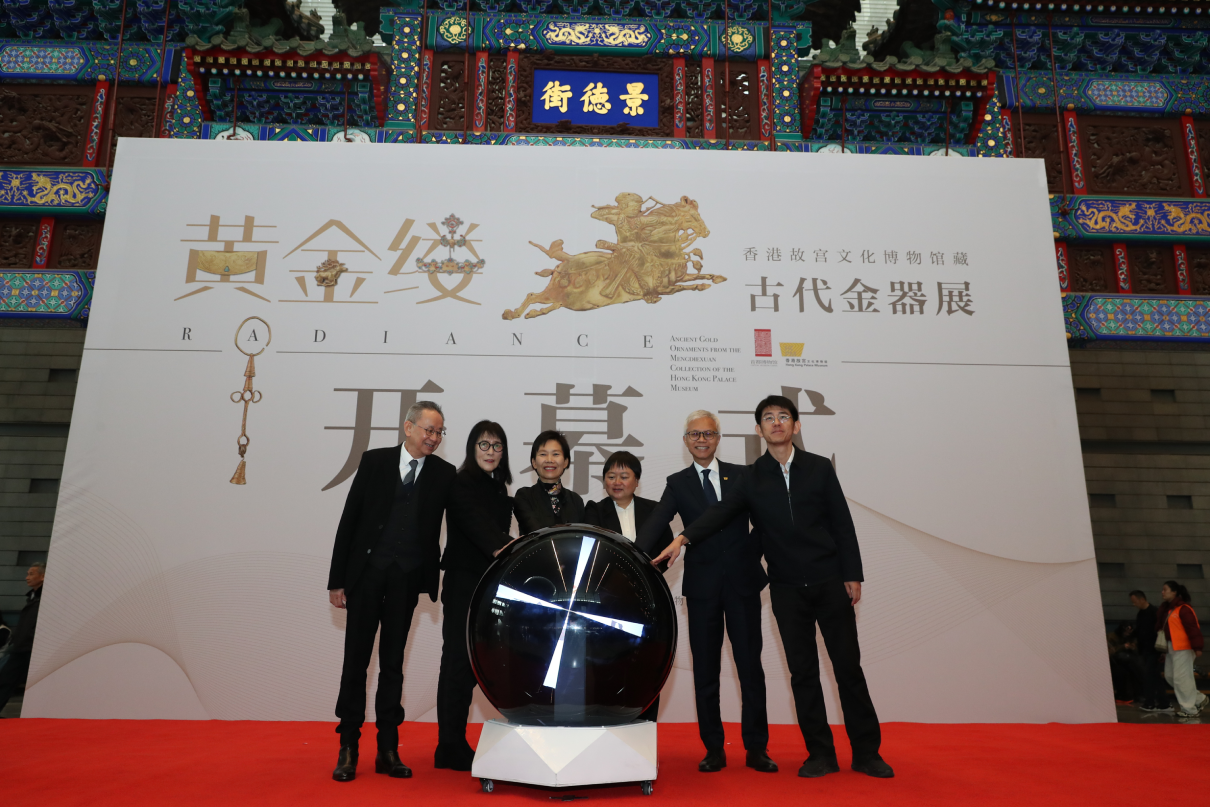
The Hong Kong Palace Museum (HKPM) and the Capital Museum jointly unveiled “Radiance: Ancient Gold Ornaments from the Collection of the Hong Kong Palace Museum” (“Radiance”) today at the Capital Museum in Beijing. Running from 22 October 2025 to 1 March 2026, the exhibition marks the first travelling exhibition of the HKPM’s collection. Admission is free to the public.
“Radiance” presents 170 sets of exquisite gold objects generously donated to the HKPM by the Mengdiexuan Collection, dating from the 15th century BCE to the Ming dynasty. This exhibition offers a comprehensive showcase of the achievements of Chinese gold craftsmanship spanning more than three millennia. Under the theme “Gold as a Thread Bridging Cultures”, it examines the production, usage, and dissemination of gold across the Eurasian steppes, Central Plains, and the Qinghai-Tibetan plateau, highlighting gold artefacts as vital witnesses to cultural exchange and integration.
Dr Louis Ng, Museum Director, HKPM, said, “Leveraging Hong Kong's distinctive advantages of strong national support and deep global connections, the Hong Kong Palace Museum is dedicated to promoting and fostering the inheritance of fine traditional Chinese culture while facilitating artistic and cultural exchange between China and the international community. This exhibition marks a significant milestone as the HKPM’s first travelling exhibition featuring its own collection since opening. Our collaboration with the Capital Museum underscores the profound bond between Hong Kong and the Mainland, especially with the capital of our nation. The exhibits are all precious items from the collection of the HKPM, and the generous donations from the Mengdiexuan Collection have laid a solid foundation for the Museum's collection, for which I extend my heartfelt gratitude.”
Ms Betty Lo and Mr Kenneth Chu, Owners of the Mengdiexuan Collection, said, “It brings us immense pleasure to witness our donation embark on its journey from the Hong Kong Palace Museum, making its debut touring exhibition at the Capital Museum. As Hong Kong collectors, we have always believed these gold artefacts, which embody the rich legacy of Chinese civilisation, should be shared with a wider audience. We eagerly anticipate this collection travelling to more cities across the Mainland and ultimately gracing the international stage.”
A triptych of cultural encounters
“Radiance” is divided into three sections:
Section 1 “Origins: The Steppe and Early China” traces the journey of gold from the Eurasian steppes into China, exploring how aristocratic groups from the Shang through Han dynasties gradually embraced gold ornaments, forming a tangible link in the frequent interactions between Central Plains and steppe cultures.
Section 2 “Exchange: Tang and Tubo” presents the dynamic exchange and interaction between Tang dynasty gold craftsmanship and the cultures of Tibet and other western regions, facilitated by the Tang dynasty’s openness and inclusivity. The exhibits embody both imperial grandeur and the rich cultural diversity that flourished along the Silk Roads.
Section 3 “Convergence: Liao, Song to Ming” showcases exquisite gold artefacts from the Liao, Song, Yuan, and Ming dynasties, illustrating the gradual fusion of steppe traditions with Central Plains customs and highlighting the inclusive nature of Chinese civilisation.
Splendours on show: where artistry meets craftsmanship
The exhibition features a diverse array of artefacts, including accessories, belt ornaments, ornaments for chariots and horses, and ritual tools—each distinguished by its unique form and exquisite craftsmanship. Among the highlights is a flared gold ornament dating back to the 15th to 13th century BCE, testifying to the eastward transmission of gold-working techniques from the western reaches of Eurasia. Plaques in the form of coiled animal motifs from the Warring States period to the Han dynasty reflect the steppe aristocracies’ favour for decoration with animal patterns. Gold adornments from the Tang dynasty exemplify the dazzling multicultural influences exchanged along the Silk Roads, while belt hooks and headdresses from the Liao and Song dynasties reveal the profound integration of Central Plains traditions with northern steppe cultures. A headdress with dragons chasing a pearl from the Ming dynasty, the very first item acquired by the HKPM, is also on display.
Furthermore, the exhibition traces the evolution of gold-working techniques—from early methods such as hammering and casting to more complex later processes including gilding, granulation, and gemstone inlay. Visitors will not only admire the artistic beauty of these gold artefacts but also appreciate the exceptional skill and wisdom of ancient artisans.
A timeless witness to exchange between civilisations
As a cornerstone of the HKPM’s collection, these gold artefacts hold profound significance that transcends their artistic brilliance. They embody millennia of cross-cultural dialogue, weaving together narratives between nomadic and agrarian civilisations, as well as Eastern and Western cultures, serving as tangible evidence of the unity in diversity that characterises Chinese civilisation. This exhibition offers audiences in the capital city an exceptional opportunity to view these ancient gold treasures up close and explore the sophisticated civilisations they represent. It also acts as a catalyst for deeper research collaboration and cultural exchange between museums in Hong Kong and Beijing.
The Mengdiexuan Collection is renowned for its exquisite quality and extensive volume of ancient Chinese ornaments. It has donated nearly 1,400 pieces to the HKPM, solidifying its leadership in collecting ancient Chinese gold and silver artefacts. The HKPM has curated several exhibitions featuring its collection, such as the special exhibition “Radiance: Ancient Gold from the Hong Kong Palace Museum Collection and the Mengdiexuan Collection” in 2023, which was the largest exhibition of Chinese ancient gold ornaments in Hong Kong in recent years.
Remarks
About the Hong Kong Palace Museum
Through innovative curatorial approaches, the Hong Kong Palace Museum presents priceless treasures from The Palace Museum along with the finest collections from other world-�renowned institutions. The Museum is also in the process of building its own world-class collection. Opened in 2022, the Museum is a leading institution for the study and appreciation of Chinese art and culture and the promotion of dialogue among world civilisations. The Museum is a collaborative project between the West Kowloon Cultural District Authority and The Palace Museum. The Hong Kong Jockey Club Charities Trust made a donation of HK$3.5 billion for its establishment, as well as some of the annual exhibitions and education programmes in 2023–2032.
Through research, exhibitions, publications, and educational and professional exchange programmes, the Museum builds international partnerships and positions Hong Kong as a global hub for art and culture. A resource that belongs to the local community, the Museum inspires community engagement, fosters dialogue, and promotes creativity and interdisciplinary collaboration.
About the West Kowloon Cultural District (WestK)
WestK is one of the largest and most ambitious cultural hubs in the world and Hong Kong’s new cultural tourism landmark, spanning 40 hectares alongside Victoria Harbour. WestK comprises a mix of landmark arts and cultural facilities, including world-class museums M+ and the Hong Kong Palace Museum, intricately designed performing arts venues the Xiqu Centre and Freespace, the 11-hectare Art Park with a waterfront promenade, and the upcoming WestK Performing Arts Centre.
Hosting over 1,000 exhibitions, performances, programmes, and events each year, WestK provides a vital platform for both emerging and established artists. WestK welcomes more than 10 million visitors each year, evolving as the international cultural brand of Hong Kong and strengthening the city’s strategic role as an East-meets-West centre for international cultural exchange.
https://www.westk.hk
About the Capital Museum
The Capital Museum began its preparatory work in 1953 and officially opened to the public in 1981. Its original location was the Beijing Confucius Temple, a nationally protected cultural heritage site. Later, a new museum building was constructed at 16 Fuxingmenwai Street in Xicheng District, Beijing. The current venue, with a total floor area of 64,000 square meters, officially opened on 18 May 2006. As a comprehensive museum affiliated with the municipal government of Beijing, it houses over 120,000 cultural artefacts that reflect Beijing's 500,000 years of human settlement, 3,000 years of urban history, and 870 years as a national capital. The museum presents a range of thematic exhibitions exploring the splendours of Chinese civilisation, the wisdom of Beijing, and the dialogue among world civilisations.