The Hong Kong Palace Museum (HKPM or the Museum) and the Palace Museum today jointly unveiled the new thematic exhibition “The Hong Kong Jockey Club Series: The Forbidden City and the World—Cultural Encounters” (“The Forbidden City and the World”). Positioned within a global context, the exhibition presents the Forbidden City as a vital platform for dialogue between China, other parts of Asia, and Europe. Spanning more than 600 years of history, the Yuan (1271–1368), Ming (1368–1644), and Qing (1644–1911) dynasties, the exhibition weaves a rich tapestry of interactions in diplomacy, trade, science and technology, philosophy, and craftsmanship, inviting visitors to appreciate the rich cultural legacy embodied by the Forbidden City. Jointly organised by the HKPM and the Palace Museum, and solely sponsored by The Hong Kong Jockey Club Charities Trust, the exhibition will open to the public tomorrow (3 June) in Gallery 1 of the HKPM.
Since its opening in 2022, the HKPM has maintained a close partnership with the Palace Museum to promote Chinese culture and foster cultural exchange between China and the rest of the world by co-organising numerous exhibitions and bringing a total of over 2,200 treasures from the Palace Museum collection to Hong Kong. In 2026, the two museums are presenting four new thematic exhibitions in succession. Among them, “The Hong Kong Jockey Club Series: The Forbidden City and the World—Cultural Encounters” presented in Gallery 1, serves as an introduction to the history and culture of the Forbidden City, providing context for other thematic exhibitions featuring objects from the Palace Museum.
“The Forbidden City and the World” showcases over 130 precious artefacts from three premier institutions: the Palace Museum in Beijing, the HKPM, and the Museum of Islamic Art in Doha. Anchored by the Palace Museum’s collection, including 18 grade-one national treasures, the display is further enriched by significant objects from the HKPM, the Chris Hall Collection at the HKPM, and the Museum of Islamic Art in Doha, with categories ranging from paintings and calligraphic works to jewellery, timepieces, ceramics, glassware, furniture, textiles, and scholar’s objects.
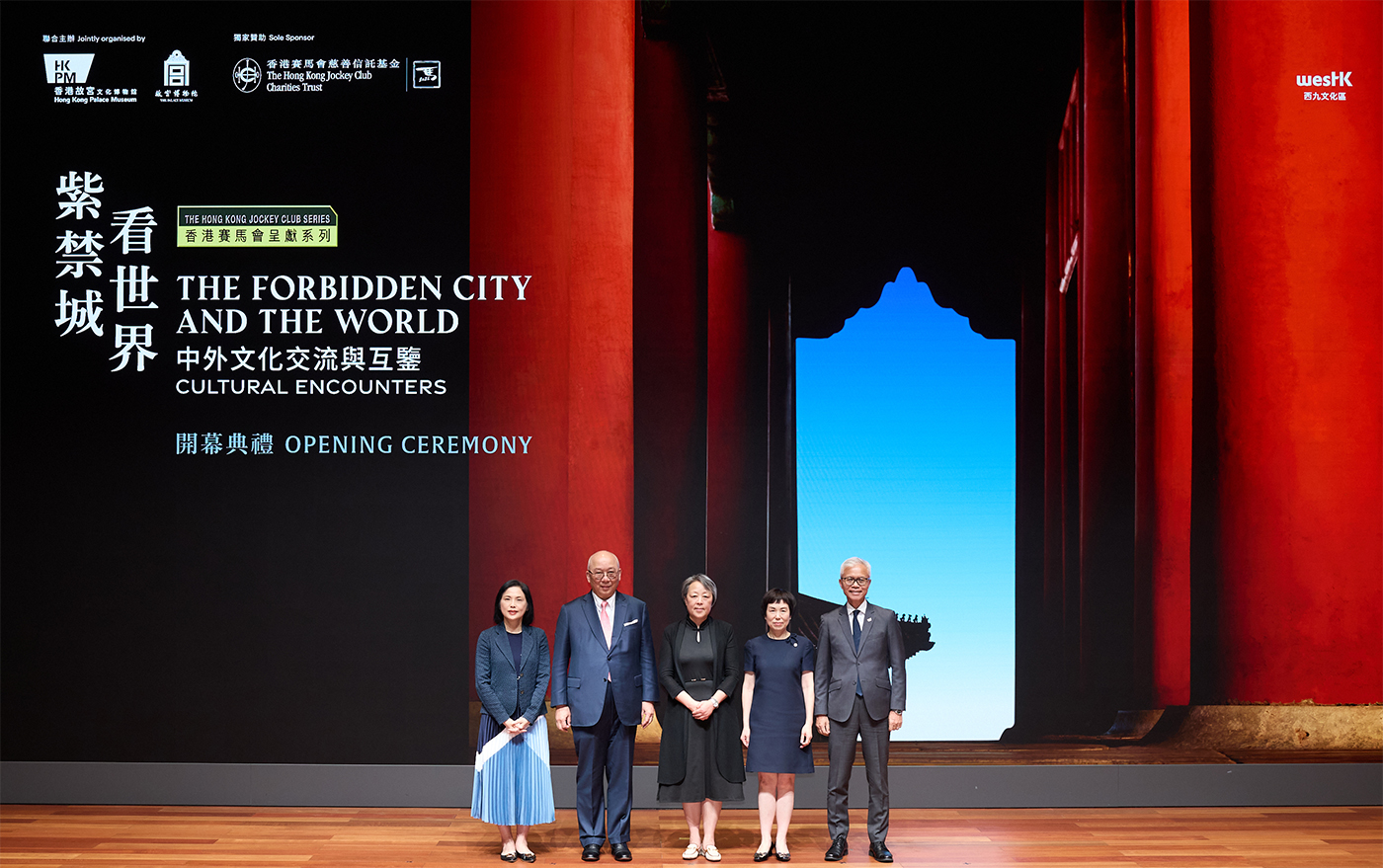
Today’s opening ceremony at the HKPM in the West Kowloon Cultural District was officiated by Zhu Hongwen, Deputy Director of the Palace Museum; Leo Kung, Chairman of the HKPM Board; Winnie Yip, Head of Charities (Culture & Sports Cluster; Community Engagement), The Hong Kong Jockey Club; Betty Fung, Chief Executive Officer of the West Kowloon Cultural District Authority; and Dr Louis Ng, Museum Director of the HKPM.
Zhu Hongwen, Deputy Director of the Palace Museum, said, “The Palace Museum has long been committed to presenting the history and spirit of Chinese civilisation through its rich and exceptional collections. ‘The Forbidden City and the World’ continues and furthers our collaboration with the Hong Kong Palace Museum. Through exceptional artefacts and innovative curatorial approaches, the exhibition brings to life China’s rich cultural legacy embodied by the Forbidden City and its open, outward-looking vision. It offers the audience a deeper understanding of the enduring and far-reaching exchanges and mutual influences between China and the wider world, while encouraging appreciation of Chinese art and culture from diverse perspectives. I would also like to express my gratitude to The Hong Kong Jockey Club Charities Trust for its generous support of this exhibition.”
Leo Kung, Chairman of the HKPM Board, said, “The treasures featured in ‘The Forbidden City and the World’ have been carefully selected by the curatorial team to reflect the Forbidden City’s historical role as a hub of cultural exchange between China and the world during the Ming and Qing dynasties. It is especially meaningful that this exhibition is presented in Hong Kong as it resonates with the city’s multiculturalism and echoes the core mission of the Hong Kong Palace Museum in deepening understanding and appreciation of Chinese art and culture while promoting dialogue among world civilisations. We warmly invite members of the public and tourists to join us in tracing the long pathways of civilisations and to keep the conversation among cultures alive.”
Winnie Yip, Head of Charities (Culture & Sports Cluster; Community Engagement), The Hong Kong Jockey Club, said, “The realisation of this exhibition would not have been possible without the profound partnership established between the Jockey Club and the Palace Museum. In 2016, The Hong Kong Jockey Club Charities Trust donated HK$3.5 billion – its single largest donation – enabling construction of the Hong Kong Palace Museum to showcase such national-level treasures. At the same time, it has enabled the Hong Kong Palace Museum to promote Chinese culture and art, carry out Chinese artefact restoration and conservation projects, and organise major exhibitions under ‘The Hong Kong Jockey Club Series’ between 2023 and 2032. The Hong Kong Palace Museum has become an important platform for both citizens and tourists to appreciate the essence of Chinese traditional culture and art, and this exhibition is one of its remarkable outcomes.”
Through rare treasures exploring cross-cultural exchanges in three dynasties
As the imperial palace of the Ming and Qing dynasties, the Forbidden City served not only as the centre of political power but also as a stage for interactions between China and the wider world. “The Forbidden City and the World” brings together over 130 exceptional treasures, spanning a wide range of categories, from paintings and calligraphic works to jewellery, timepieces, ceramics, glassware, furniture, textiles, and scholar’s objects. Every three months, a number of new objects will be displayed and each rotation presents approximately 80 artefacts.
The exhibition has four sections:
The first section “Routes of Exchange—Marco Polo and Zheng He” charts China’s flourishing cultural encounters with other regions during the Yuan and Ming dynasties. From the interconnected overland Silk Routes to maritime trade routes, it paints a vivid picture of China’s growing contact with the wider world. Among the highlights is a piece of Mounting fabric with patterns of cranes, deer, and persimmon pedicels from the Hongwu period (1368–1398) of the Ming dynasty, to be displayed for three months. Beginning with his first mission abroad for the Ming dynasty, diplomat Zheng He (d. 1433) brought patterned textiles woven with gold and silk threads as gifts and was prepared to speak the language of prestige and alliance. In the course of his seven major maritime expeditions, he took Chinese textiles as far as Southeast Asia, the Indian subcontinent, West Asia, the Arabian Peninsula, and East Africa. This section also includes one of the exhibition’s oldest works: a Mosque lamp with a verse from Qur’an, dating back to the late Yuan or early Ming period. It serves as a testament to the longstanding exchange of objects and ideas between China and West Asia.
The second section “Imported Treasures—Ming Court Art and New Knowledge of the World” illustrates the historical context of rare commodities imported to China from South and Southeast Asia during the late Ming period, and their significant impact on imperial art and craftsmanship in the Ming and Qing dynasties, reflecting Chinese culture’s inclusiveness and inventiveness. Among the highlights of this section are two grade-one national treasures: a Ruyi sceptre in the form of lingzhi fungus and a sapphire Pendant, as well as the Copy of Jiang Tingxi’s Album of Birds. Intricately shaped from a single piece of Burmese jadeite, the ruyi sceptre is one of the few surviving examples of its kind. As rubies and sapphires from Southeast and South Asia entered the imperial court in greater quantities, gemstone inlay techniques were increasingly used in making jewellery and decorating court vessels. The Album of Birds, commissioned by the Qianlong Emperor (r. 1736–1795), takes the form of a richly illustrated encyclopaedia and documents exotic species with unprecedented precision. On display for only three months is a painting featuring a kingfisher from Siam (modern-day Thailand) from the album. Birds of this species were among the gifts presented to the Qing court from Siam and Champa (modern-day Central Vietnam).
The third section “East Meets West—Artistic and Scientific Exchanges in the Qing Dynasty” highlights the spirit of artisanal innovation and the integration of knowledge during the Kangxi (1662–1722), Yongzheng (1723–1735), and Qianlong reigns of the Qing dynasty. A Geometric polyhedron model shows the Kangxi Emperor’s keen interest in mathematics and his open‑minded engagement with foreign knowledge. A very special work is a painting titled Fighting tiger from Yinzhen’s Amusements, depicting Prince Yinzhen (the future Yongzheng Emperor) hunting a tiger. In this scene, the prince wears European-style attire and a Western-style wig, revealing Yinzhen’s fascination with the novel and the exotic. A Luohan bed with figures featuring scenes of merchants and envoys carrying foreign treasures offers a window into how Europeans were perceived in China during the Qing period.
The fourth section “The Emperor’s Southern Treasury—The Canton Customs and the World” examines how the Canton Customs shaped court culture from the mid- to late Qing dynasty. In 1757, Guangzhou’s Canton Customs was the only designated seaport open to foreign merchants. The imperial court granted a legal monopoly over trade between China and foreign countries to the Thirteen Factories, a consortium of licensed merchant firms there. Among the most important commodities of exchange was tea, which helped spark a taste for tea drinking across Europe and even inspired the development of European tea services. On display is a striking example: an Iris-decorated kettle with handle, crafted during the Meiji period (1868–1912) in Japan, which deliberately echoes the forms of European silverware. Merchants of the Thirteen Factories collected exotic goods to trade and brought back curiosities for Chinese emperors. Exhibits such as the Singing bird cage automaton and Adjustable nearsighted glasses bear witness to this history of exchange.
Discover China’s global encounters through innovative design and engaging experience
The design of the exhibition employs colour and spatial choreography to shape a visitor journey that unfolds step by step. In the first section, red is the dominant tone, complemented by column-inspired structures that evoke the palatial atmosphere of the Forbidden City. The setting draws visitors into a narrative of Sino-foreign exchange from an imperial perspective. In the fourth section, blue takes centre stage, echoing the refined hues of the exhibits and recalling Guangzhou’s historical role as a hub of maritime trade. Specially commissioned videos are presented at both the entrance and exit to the exhibition. The opening video, produced in collaboration with the Design and Cultural Studies Workshop led by Mr Chiu Kwong-chiu, uses animation to illustrate how the Forbidden City was shaped by its encounters with the world. The closing video chronicles the Palace Museum’s contributions to Sino-foreign cultural exchange over its centennial history, alongside the HKPM's efforts to foster global cultural dialogue since its opening in 2022.
The exhibition features a suite of multimedia elements that enrich the overall visitor experience:
- A digital “Qianlong Garden” (Palace of Tranquil Longevity): Embellished by the garden’s perspectival wall paintings, this digital garden lively presents rare creatures from across the world, inviting visitors to embark on a journey of discovery. The perspectival wall paintings, an interior decorative painting popular during the Qianlong reign, reconcile Western linear perspective with architectural setting.
- The interactive “What Did the Kangxi Emperor Study?” shows how knowledge from Europe was selectively received, studied, and integrated into the Qing court in the Kangxi period, offering insight into the processes that underpin Sino‑European intellectual exchange.
- Adjacent to the historical timepieces on display is a video revealing the mechanical movements, design aesthetics, and harmonious chimes of a musical clock from the collection of the HKPM, bringing to life this masterpiece.
- Through an animated video depicting scenes of attracting foreign merchants, inspecting samples, negotiating, packing, and weighing at the Thirteen Factories of Guangzhou during the Qing dynasty, visitors can step into the shoes of 18th-century European traders to explore the tea trade.
In conjunction with “The Forbidden City and the World”, the Museum will present a series of educational programmes through its Palace Academy, including guided tours, workshops, and public talks. In the second half of the year, the Museum will roll out various short courses related to its exhibitions, of which “The Forbidden City and the World” will be a highlight subject. To support teachers’ planning of curriculum-related museum activities and facilitate students’ learning in the gallery, the Museum will organise educator engagement events and briefing sessions, as well as publishing an illustrated exhibition guidebook to help students better understand this exhibition and broader cultural exchange issues. Given the exhibition’s rich variety of objects and its role as an orientation exhibition for visitors entering the HKPM, the Museum will also offer an extended audio guide with 20 tracks featuring highlight objects and stories, available in three languages: Cantonese, Putonghua, and English. Guided by the extended audio guide, visitors can explore an unprecedented breadth of treasured objects in a single visit. They can explore the stories across categories, materials, and regions, taking an in-depth journey through the vibrant cross-cultural exchanges of Ming and Qing China in areas such as diplomacy, commerce, science and technology, and craftsmanship. More details regarding exhibition-related activities will be announced in due course. Please refer to the HKPM website for more information.
“The Hong Kong Jockey Club Series: The Forbidden City and the World—Cultural Encounters” will open to the public on 3 June 2026 in Gallery 1 of the HKPM. Visitors can access this exhibition with a General Admission ticket (Galleries 1 to 7; priced at HK$70 for adults and HK$35 for concessions*) or a Special Exhibition ticket. Tickets are available for sale or reservation via the HKPM website, the WestK website or mobile app, the WestK ticketing’s WeChat mini programme, and the online platforms of the Museum’s ticketing partners.
*Concessions are available to children aged 7 to 11, full-time students, seniors aged 60 and above, persons with disabilities (with one companion), and CSSA recipients. Free entry for children aged 6 and under.
Remarks
About the Hong Kong Palace Museum
Through innovative curatorial approaches, the Hong Kong Palace Museum presents priceless treasures from the Palace Museum along with the finest collections from other world-renowned institutions. The Museum is also in the process of building its own world-class collection. Opened in 2022, the Museum is a leading institution for the study and appreciation of Chinese art and culture and the promotion of dialogue among world civilisations. The Museum is a collaborative project between the West Kowloon Cultural District Authority and the Palace Museum. The Hong Kong Jockey Club Charities Trust made a donation of HK$3.5 billion for its establishment, as well as some of the annual exhibitions and education programmes in 2023–2032.
Through research, exhibitions, publications, and educational and professional exchange programmes, the Museum builds international partnerships and positions Hong Kong as a global hub for art and culture. A resource that belongs to the local community, the Museum inspires community engagement, fosters dialogue, and promotes creativity and interdisciplinary collaboration.
About the Palace Museum
Established in 1925, the Palace Museum is a comprehensive museum built on the foundations of the Ming and Qing imperial palaces, the Forbidden City, integrating architecture, cultural relics, and the rich historical and cultural heritage of the imperial courts. In 1961, the State Council listed it as one of the first batch of “Major National Cultural Heritage Sites”, and in 1987, it was designated a World Heritage Site by UNESCO. The Palace Museum became a National 5A Tourist Attraction in 2007. The following year, it was among the first Chinese museums recognised by the National Cultural Heritage Administration as a “National First-level Museum”. The Palace Museum spans a total area of 106 hectares and has a total construction area of 233,300 square metres, making it the world’s largest and best-preserved historical palatial complex.
Today, the Palace Museum is an unparalleled art treasure house with a vast collection of over 1.95 million items/sets in twenty-five major categories. It showcases the time-honoured and splendid Chinese civilisation to the public through its imperial palace architecture; the display of original interior settings to illustrate the history of the imperial court; galleries dedicated to decorative arts, timepieces, paintings, calligraphic works, ceramics, and sculptures; and thematic exhibitions.
About the West Kowloon Cultural District (WestK)
WestK is one of the largest and most ambitious cultural hubs in the world and Hong Kong’s new cultural tourism landmark, spanning 40 hectares alongside Victoria Harbour. WestK comprises a mix of landmark arts and cultural facilities, including world-class museums M+ and the Hong Kong Palace Museum, intricately designed performing arts venues the Xiqu Centre and Freespace, the 11-hectare Art Park with a waterfront promenade, and the upcoming WestK Performing Arts Centre.
Hosting over 1,000 exhibitions, performances, programmes, and events each year, WestK provides a vital platform for both emerging and established artists. WestK welcomes more than 10 million visitors each year, evolving as the international cultural brand of Hong Kong and strengthening the city’s strategic role as an East-meets-West centre for international cultural exchange.
https://www.westk.hk/