
Hong Kong Palace Museum | Radiance: Ancient Gold Ornaments from the Collection of the Hong Kong Palace Museum

Map

Hong Kong Palace Museum

West Kowloon Cultural District, 8 Museum Drive, Kowloon


Mon, Wed, Thu & Sun
10:00 am–06:00 pm
Fri, Sat & Public Holiday
10:00 am–08:00 pm | Closed on Tuesdays (except public holidays) & the first two days of the Lunar New Year
2024-2025 web-accessibility.hk GOLD Award 2024-2025 web-accessibility.hk elderly friendly

Copyright © Hong Kong Palace Museum. All rights reserved
Important notice
x

Home Exhibitions

Radiance: Ancient Gold Ornaments from the Collection of the Hong Kong Palace Museum

22.10.2025 – 01.03.2026
Capital Museum, Beijing

“Radiance” presents 170 sets of exquisite gold objects generously donated to the HKPM by the Mengdiexuan Collection, dating from the 15th century BCE to the Ming dynasty. This exhibition offers a comprehensive showcase of the achievements of Chinese gold craftsmanship spanning more than three millennia. Under the theme “Gold as a Thread Bridging Cultures”, it examines the production, usage, and dissemination of gold across the Eurasian steppes, Central Plains, and the Qinghai-Tibetan plateau, highlighting gold artefacts as vital witnesses to cultural exchange and integration.


Details

Date 22 October 2025 (Wednesday)–1 March 2026 (Sunday)
Venue Capital Museum, Beijing


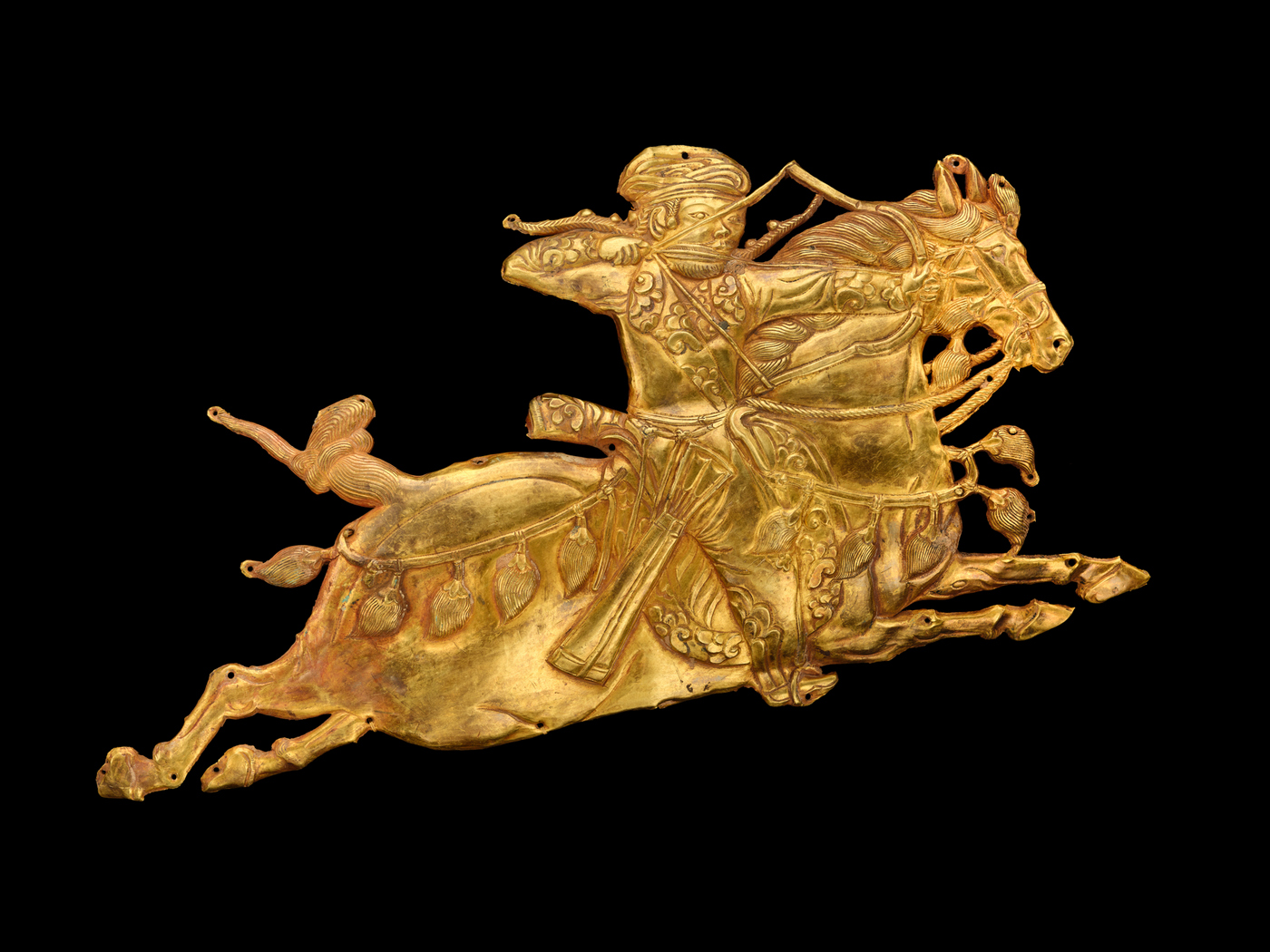
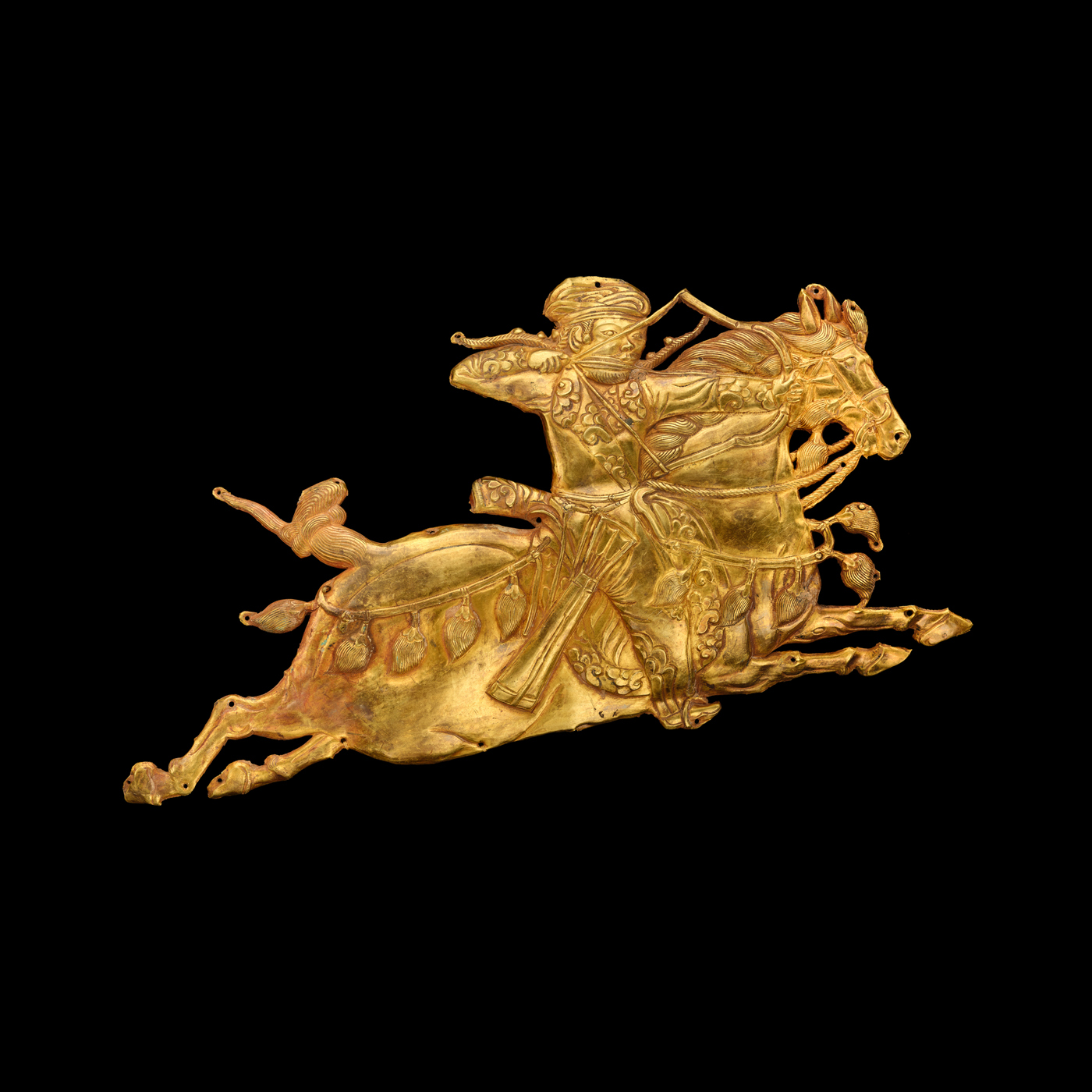
Plaque of a mounted archer

Plaque of a mounted archer
Tubo (7th–9th century)
Length: 31.1cm; Height: 17.4cm; Weight: 173.9g
Gold, wood, and lacquer
Hong Kong Palace Museum Collection, 2022.131
© Hong Kong Palace Museum

Highlighted objects

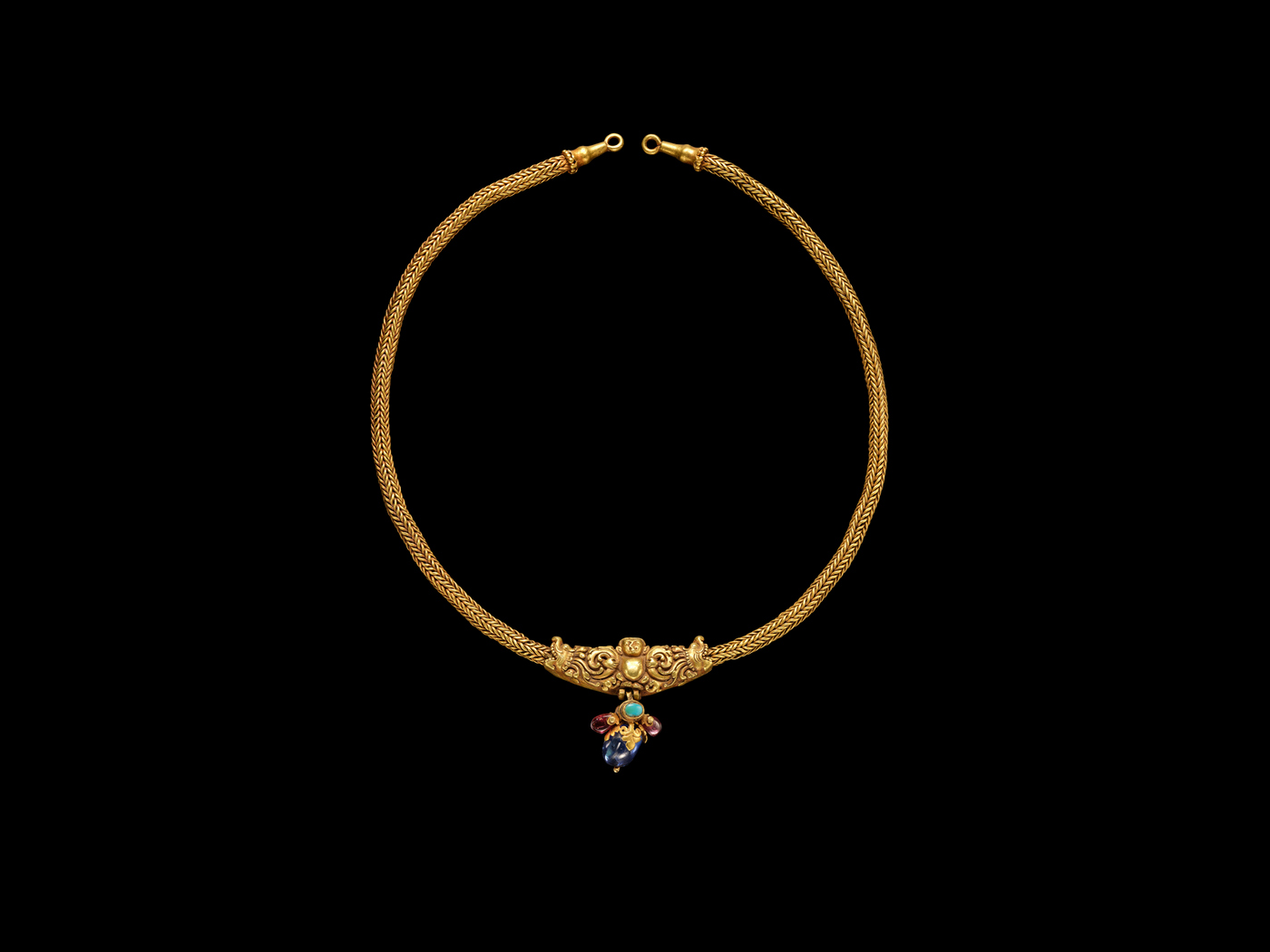
Pendant with figure and makara

Pendant with figure and makara

Northern Wei Dynasty (386-543)
Length of the chain: 47cm; Length of the pendant: 4.4cm; Weight: 119.9g
Gold, turquoise, sapphire, inlay
Hong Kong Palace Museum Collection, 2022.164
© Hong Kong Palace Museum

Pendant with figure and makara

This pendant is composed of three parts: a clasp, a chain, and a pendant drop. The entire chain is intricately woven using eight gold wires in a double-layered, double-loop interlinking technique, and is secured to the pendant below with a gold pin. The pendant itself is especially exquisite, featuring a central human figure. In addition to the eyes, a hole is pierced in the forehead in the shape of a “third eye” or “divine eye”. The figure is depicted with a protruding belly, holding the tails of two makaras—mythical sea creatures—one in each hand. The makaras have wide-open mouths, from which the chain emerges on both sides. Beneath the figure is a movable link connecting to a cross-shaped floral drop, which is inlaid with red, blue, and green gemstones, adding vibrant luster to the brilliance of the gold necklace. The double-makara motif with a central human figure resembles imagery found in earlier jewelry from the Kushan Empire in Afghanistan (ca. 2nd–3rd century CE). The Kushan Empire was an ancient state spanning parts of Central and South Asia, established by a branch of the Yuezhi people.

Pendant with figure and makara

Northern Wei Dynasty (386-543)
Length of the chain: 47cm; Length of the pendant: 4.4cm; Weight: 119.9g
Gold, turquoise, sapphire, inlay
Hong Kong Palace Museum Collection, 2022.164
© Hong Kong Palace Museum

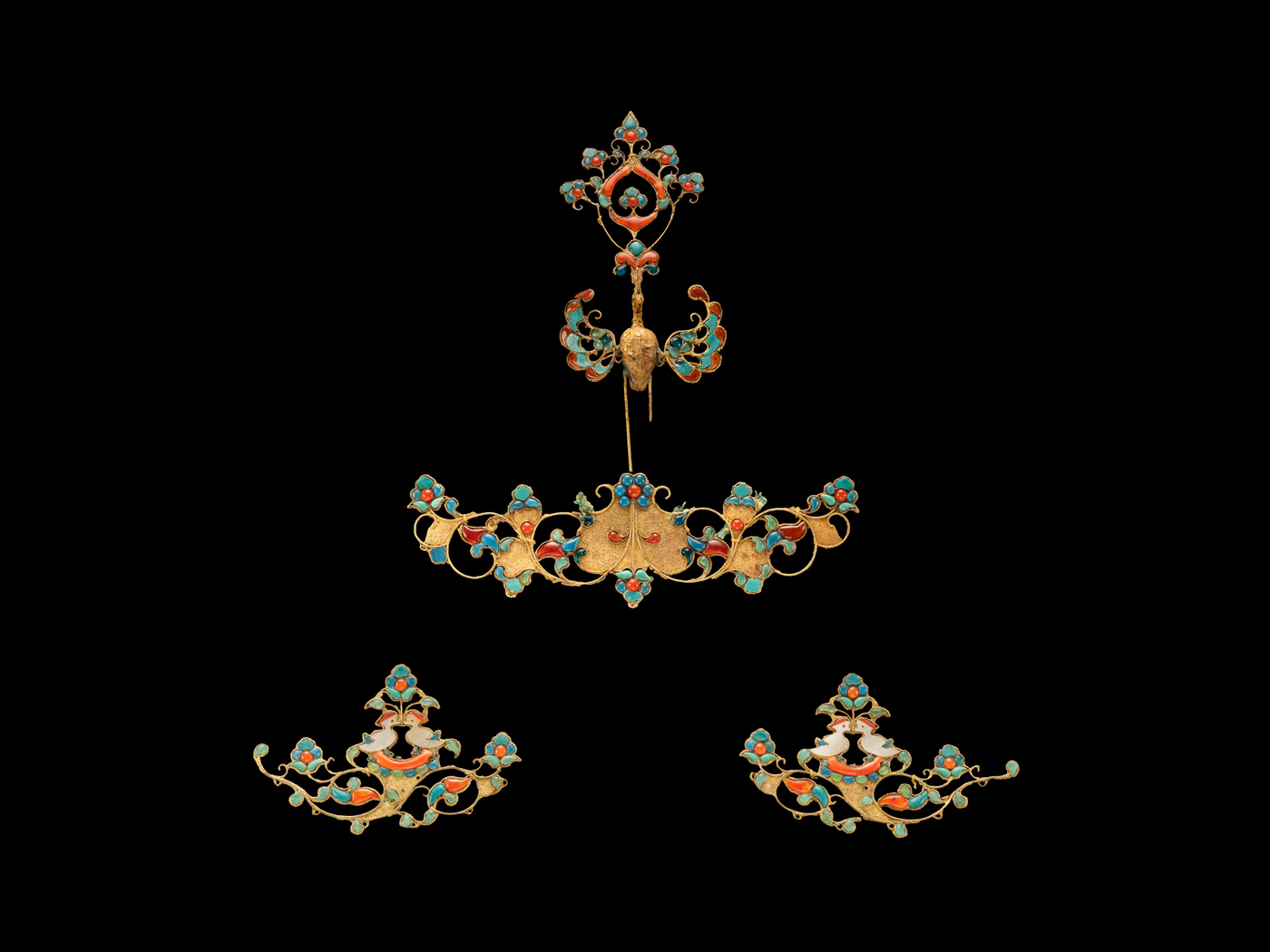
Crown ornaments with phoenix and mandarin ducks holding floral branches

Crown ornaments with phoenix and mandarin ducks holding floral branches

Tang Dynasty (618–907)
Phoenix height: 8.7cm; Width: 5cm; Weight: 3.4g
Gold with turquoise, agate, glass, and shell inlay
Hong Kong Palace Museum Collection, 2022.195.1-4
© Hong Kong Palace Museum

Crown ornaments with phoenix and mandarin ducks holding floral branches

This crown ornaments consist of a phoenix figure and three additional plaques, originally designed to be attached to a crown. The phoenix’s body is formed from two hammering gold sheets, while its wings and tail are made of openwork gold pieces outlined with fine gold wire and adorned with turquoise, red agate, cobalt-blue glass, and granulations. The three accompanying plaques are decorated with floral scrolls, using the same techniques as the phoenix. The two smaller plaques are further inlaid with paired mandarin ducks carved from mother-of-pearl. A similar crown ornament was worn by Princess Li Chui, upon her burial in 736 CE.

Crown ornaments with phoenix and mandarin ducks holding floral branches

Tang Dynasty (618–907)
Phoenix height: 8.7cm; Width: 5cm; Weight: 3.4g
Gold with turquoise, agate, glass, and shell inlay
Hong Kong Palace Museum Collection, 2022.195.1-4
© Hong Kong Palace Museum

Plaque of a mounted archer

Plaque of a mounted archer

Tubo (7th–9th century)
Length: 31.1cm; Height: 17.4cm; Weight: 173.9g
Gold, wood, and lacquer
Hong Kong Palace Museum Collection, 2022.131
© Hong Kong Palace Museum

Plaque of a mounted archer

This plaque features a commanding composition with a strong sense of movement. The archer wears a headscarf, from beneath which two braided strands of hair stream backward in the wind. His eyes are wide open, and a thick beard frames his face. He is shown drawing a bow, poised to shoot. The rider wears a fitted robe with a large, triangular lapel extending to the ankles, adorned with decorative borders at the cuffs, elbows, collar, front opening, and trouser hems. A belt is tied at the waist, from which a long, narrow quiver hangs, while the hilt of a patterned dagger protrudes from behind. The horse’s tail is tied in a decorative knot, and the leaf ornaments on the breast strap and crupper flutter dramatically, amplifying the sense of dynamic energy. On the reverse of the plaque, remnants of a thin wooden panel with black lacquered leather remain, attached to the plaque with gold rivets—indicating that this piece originally served as an ornament on a wooden object. The stylistic composition of the plaque recalls imperial hunting scenes found on Sasanian (224–651 CE) gold and silver wares from West Asia. However, the rider’s attire is distinctly Tubo in style. The Sassanid Empire, founded by the Persians, developed and spread Persian artistic traditions at their height, influencing regions as far-reaching as Western Europe, Africa, India, and China.

Plaque of a mounted archer

Tubo (7th–9th century)
Length: 31.1cm; Height: 17.4cm; Weight: 173.9g
Gold, wood, and lacquer
Hong Kong Palace Museum Collection, 2022.131
© Hong Kong Palace Museum

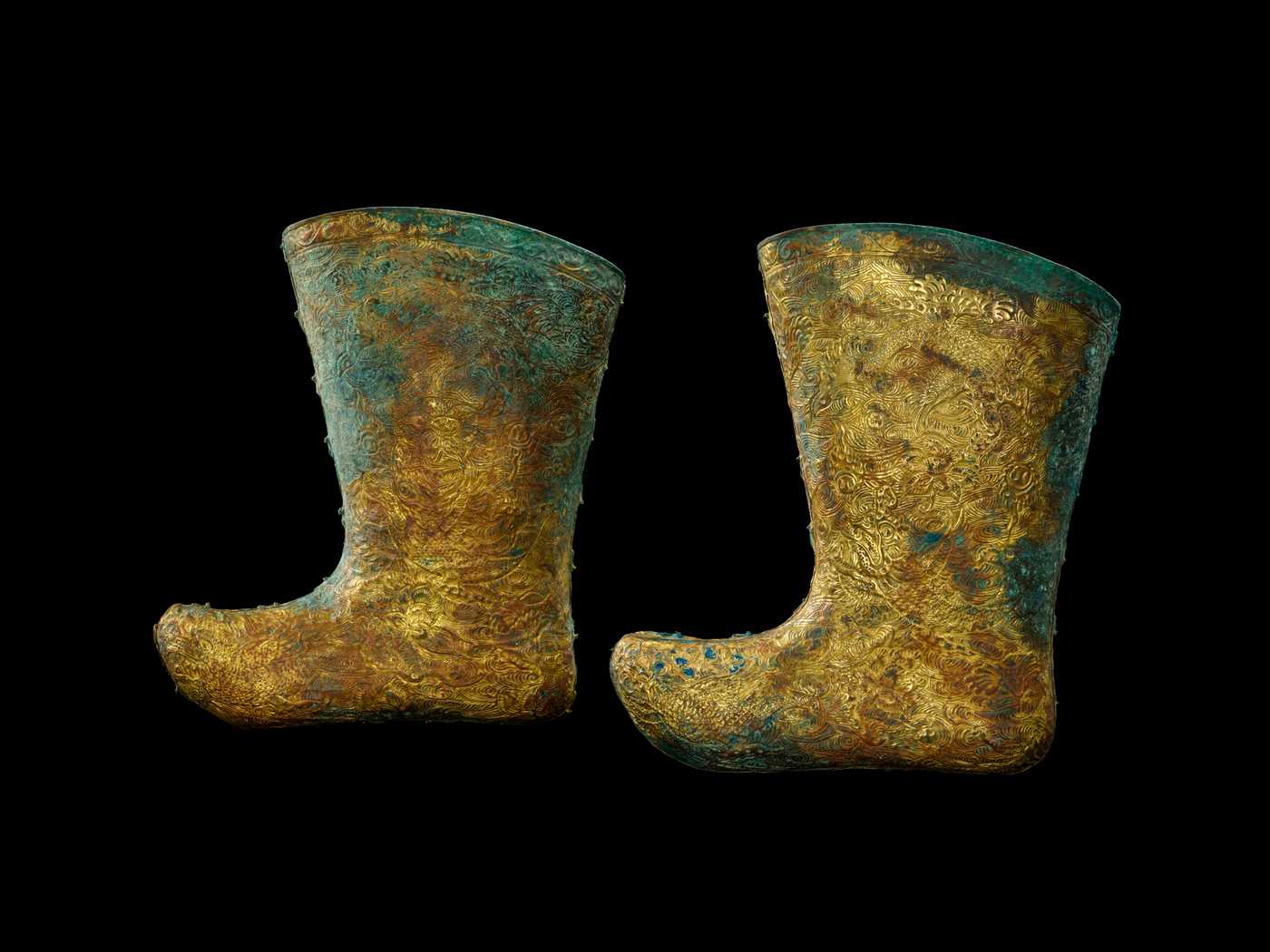
Boots with makaras chasing pearls in a lotus ground

Boots with makaras chasing pearls in a lotus ground

Liao Dynasty (907–1125)
Height: 37cm; Width: 31.5cm
Gilt copper
Hong Kong Palace Museum Collection 2024.100.1-2
© Hong Kong Palace Museum

Boots with makaras chasing pearls in a lotus ground

This pair of boots was likely made specifically for funerary purposes. While their form resembles those crafted from silk, their decoration is far more elaborate, featuring motifs of flying phoenixes, floral patterns, and swirling cloud designs. Footwear is rarely found among excavated Liao-period remains. However, a pair of phoenix-patterned silver boots adorned with gilding was unearthed from the joint tomb of Princess Chen and her consort. They were found worn over the princess’s silver wire foot net at the time of excavation.

Boots with makaras chasing pearls in a lotus ground

Liao Dynasty (907–1125)
Height: 37cm; Width: 31.5cm
Gilt copper
Hong Kong Palace Museum Collection 2024.100.1-2
© Hong Kong Palace Museum

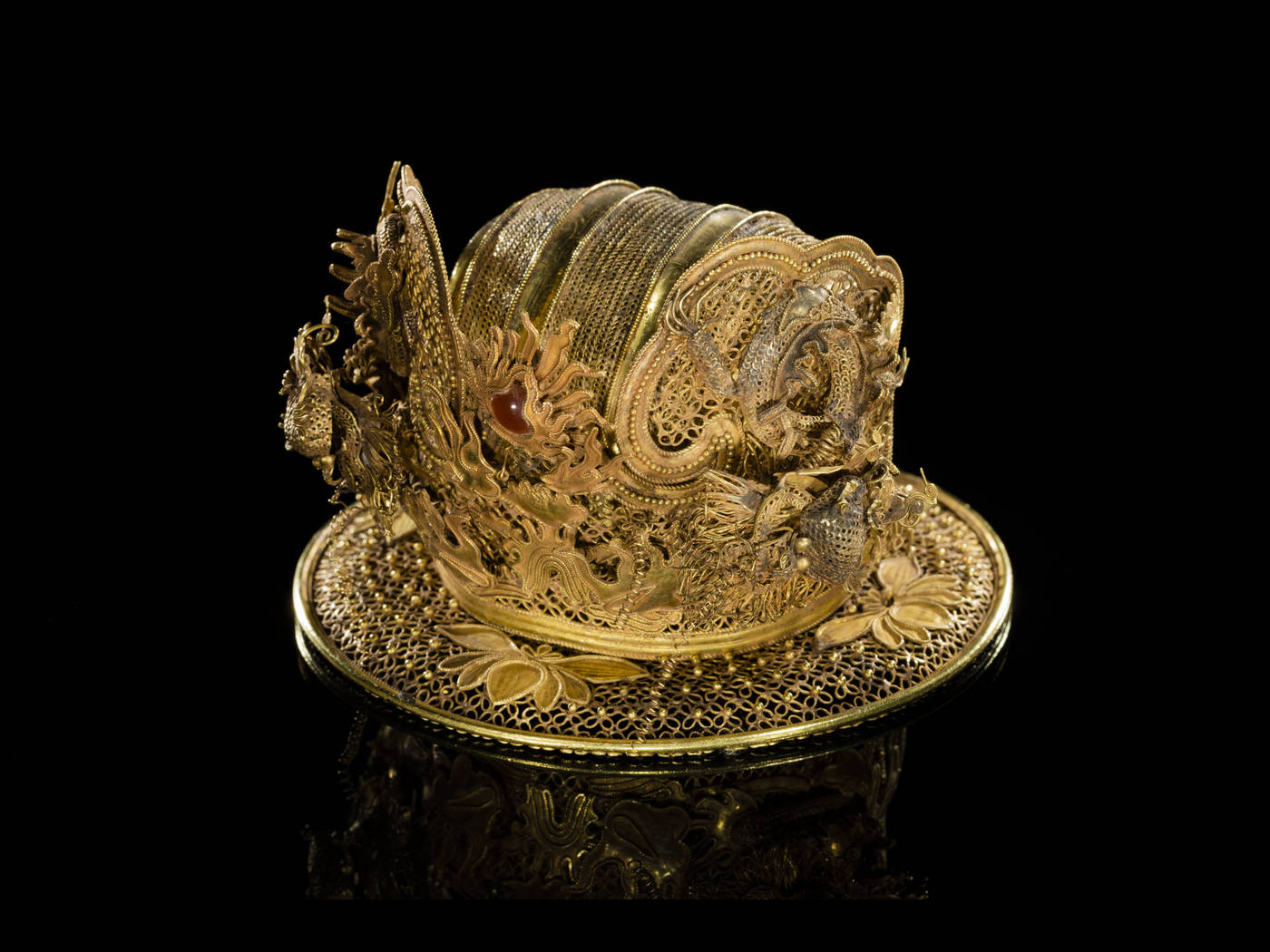
Crown with dragons chasing a pearl

Crown with dragons chasing a pearl

Ming dynasty (1368–1644)
Height: 6.4cm; Diameter: 9.6cm
Gold with ruby inlay
Gift of Mengdiexuan
Hong Kong Palace Museum, 2022.1
© Hong Kong Palace Museum

Crown with dragons chasing a pearl

This bun crown is made using filigree techniques. The top is hemispherical with six ridges, and the base is a flattened circular collar. At the back rise two wing-shaped decorative panels. The decoration of this hair crown is intricate and magnificent: the top and bottom are further adorned with bat and lotus-shaped ornaments. The beam-cover is chiselled with beaded patterns and rolling cloud patterns; the double wings at the bottom are woven with gold threads. The wings are decorated with the five-clawed dragons (woven with gold threads) playing with a pearl, with the fire pearl inlaid with a ruby. The dragons’ necks are attached with springs, causing the heads to sway with a remarkably lifelike movement.

Crown with dragons chasing a pearl

Ming dynasty (1368–1644)
Height: 6.4cm; Diameter: 9.6cm
Gold with ruby inlay
Gift of Mengdiexuan
Hong Kong Palace Museum, 2022.1
© Hong Kong Palace Museum

Become HKPM Friends

Enjoy unlimited visit to all thematic exhibitions

Join now

Stay connected

  • Stay tuned for upcoming events and other Museum news
  • Receive updates about your areas of interest
Top
Hong Kong Palace Museum
Map

Hong Kong Palace Museum

West Kowloon Cultural District, 8 Museum Drive, Kowloon


Mon, Wed, Thu & Sun
10:00 am–06:00 pm
Fri, Sat & Public Holiday
10:00 am–08:00 pm | Closed on Tuesdays (except public holidays) & the first two days of the Lunar New Year