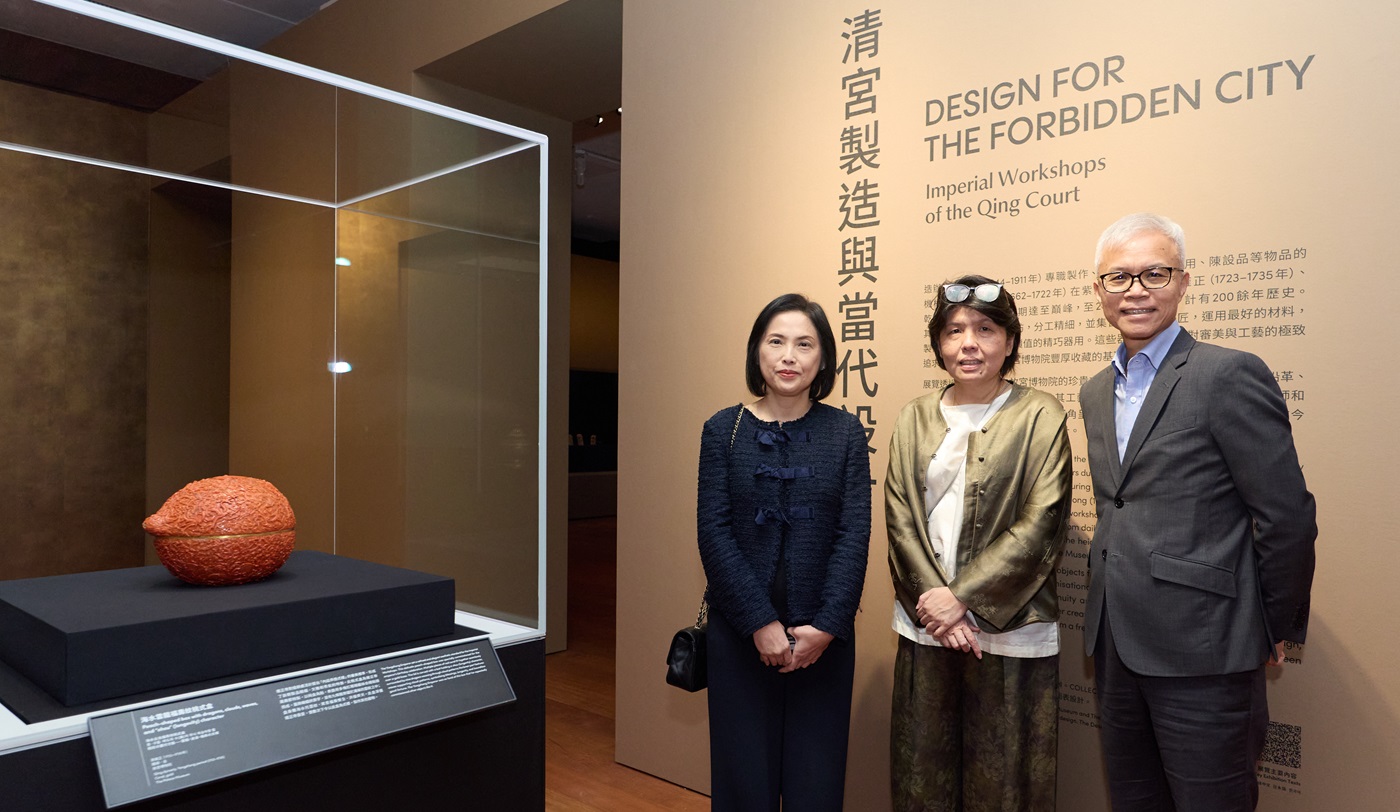
The Hong Kong Palace Museum (HKPM or the Museum) and the Palace Museum jointly present a new thematic exhibition, “Design for the Forbidden City: Imperial Workshops of the Qing Court” (“Design for the Forbidden City”), opening to the public tomorrow, 30 September 2026, in Gallery 5 of the HKPM.
Featuring 157 treasures from the Palace Museum collection, including 14 grade-one national treasures, the exhibition celebrates the artistic ingenuity and superb craftsmanship of the Qing dynasty (1644–1911). Through the lens of contemporary design, the exhibition offers rare and insightful perspectives on the operation and aesthetic codes of the Qing Imperial Workshops. Seamlessly bridging past and present, the exhibition embodies the Museum’s core vision of bringing history and cultural heritage vividly to life. By inviting Hong Kong designers and other creative talents to participate in the exhibition design, the exhibition presents court aesthetics from a fresh perspective and opens up a dialogue between Qing and contemporary life and design.
Dr Louis Ng, Museum Director of the Hong Kong Palace Museum, said, “Through our close collaboration with the Palace Museum, the Hong Kong Palace Museum continues to introduce the finest treasures of Chinese cultural heritage to Hong Kong. ‘Design for the Forbidden City: Imperial Workshops of the Qing Court’ reinterprets the excellence in traditional heritage through a contemporary lens and incorporates multimedia elements to enhance interaction, guiding audiences to experience the timeless appeal of exceptional craftsmanship. At a time when the cultural and creative industries serve as pivotal catalysts for Hong Kong’s future development, staging this exhibition in Hong Kong, Asia’s creative capital, holds profound significance. We trust it will provide inspiration and insights to both local and international audiences, particularly design professionals and emerging talents.”
Since its inaugural opening in 2022, the HKPM has worked hand in hand with the Palace Museum to champion Chinese culture and advance cultural exchange between China and the wider world. In 2026, the two institutions are jointly presenting four thematic exhibitions: “The Hong Kong Jockey Club Series: The Forbidden City and the World: Cultural Encounters” (Gallery 1), “Heavenly Horses: Masterpieces from the Palace Museum” (Gallery 4), and “Design for the Forbidden City: Imperial Workshops of the Qing Court” (Gallery 5), opening tomorrow. A fourth major exhibition, opening in November, will explore the natural cycle of the seasonal year, inviting visitors to experience the ritual calendar and evocative rhythms of court life through the four seasons (Gallery 2).
Exploring the workflow of the palace’s manufacturing institution while showcasing the pinnacle of imperial design and lifestyle
“Design for the Forbidden City” marks the first major exhibition presenting the history, organisational structure, use of materials, and production processes—as well as the artistic ingenuity and achievements—of the Imperial Workshops. The Imperial Workshops were entrusted with the vital task of supplying and maintaining the many objects used by and displayed for the emperors during the Qing dynasty. Within dozens of specialised workshops, skilled craftsmen from across China used the finest materials to produce everything from daily items to breathtaking masterpieces. The wide array of objects they created exemplifies the height of Qing court aesthetics and craftsmanship and forms a significant part of the Palace Museum’s vast collection today.
The exhibition unfolds across three sections, beginning with “About the Imperial Workshops”, which introduces these workshops administered by the Imperial Household Department and traces their origins from their establishment inside the Forbidden City during the Kangxi period (1662–1722) to their evolution into a state-wide production network spanning over two centuries. The second section, “Production and Innovation”, explores how the Workshops built upon and advanced traditional Chinese craftsmanship while actively adapting techniques from abroad during the Yongzheng (1723–1735) and Qianlong (1736–1795) periods, bringing Qing craftsmanship to its peak. Finally, “Creative Design and Display” examines contemporary design concepts, including branding, antiquarianism, and optical illusion, which can also be seen in the practices of the Imperial Workshops. This section also highlights the distinctive system of custom-made packaging and mounts developed by the Qing court.
Operating under direct imperial mandate, the Workshops revolved around the emperors, who acted not merely as the supreme authority, but also as their most influential “Chief Designers”. Highlighted exhibits illuminating the distinct aesthetics and tastes of the Kangxi, Yongzheng, and Qianlong emperors include:
- Painted enamel octagonal teapot with landscape, flowers, and birds in reserved panels: Modelled after a European silver warming pot, this exceptional enamel work reflects a specific instruction from the Qianlong Emperor, which was to adorn the handle with aventurine glass—a material exceptionally difficult to craft. The finished piece is a superb painted-enamel-on-copper masterpiece that integrates Western design influences with exceptional craftsmanship and enamel painting.
- Ewer with handle: Deeply captivated by Japanese lacquerware, the Yongzheng Emperor not only collected original pieces but also instructed the Imperial Workshops to replicate their forms using alternative materials. This teapot is a prime example: meticulously crafted in silver, it replicates a Japanese maki-e lacquer teapot with a handle. Left entirely unadorned, the piece exudes a stark, minimalist elegance.
- Peach-shaped box with dragons, clouds, waves, and “shou” (longevity) character: Custom-crafted for the Yongzheng Emperor’s birthday celebration, this box features a gold base with its surface meticulously overlaid with perfectly fitted fragments of red coral. The lid is decorated with bats surrounding the character shou (longevity) and accompanied by nine dragons leaping through intricately carved cloud patterns. The lower box features carved waves supporting cloud patterns, symbolising boundless blessings and longevity.
- Antler armchair: Constructed from antlers of deer personally hunted by the Kangxi Emperor, this extraordinary armchair showcases the exceptional craftsmanship of the Imperial Workshops while embodying the Qing imperial family’s commitment to preserving its equestrian and archery traditions. According to a poem by the Qianlong Emperor inscribed on its backboard, the chair was once displayed at the Pavilion of Winding Streams and Lotus Fragrance in the Rehe Imperial Palace.
- Filled-in lacquer dish in the shape of a lotus leaf: Mirroring the form and ornamentation of mid-Ming polychrome lotus-leaf lacquer trays, this unique object is a singular treasure in the Qing imperial collection. According to the Archives of the Imperial Workshops, the Qianlong Emperor once decreed that a lotus-leaf lacquer dish be sent to Suzhou for an exact replica to be made; this piece may correspond to the object described in the records.
- Table screen with double-dragon holding the qian trigram pattern: During the Qianlong period, craftsmen of the Imperial Workshops often repurposed ancient jade discs into table screens for decorative display. The circular wooden lid of this zitan wood screen is carved with two dragons supporting the qian trigram, a visual allusion to the reign title “Qianlong”. Employed across a variety of court objects, this pattern functioned much like an imperial emblem and exemplifies the creativity fostered by the Imperial Workshops during the Qianlong period.
Experiential design and interactive media: Living the daily lives of imperial craftsmen
Selected exhibits will rotate periodically throughout the exhibition run, presenting approximately 100 masterpieces to the public at any given time. Beyond viewing the masterfully crafted palace treasures up and close, visitors can engage with the digital installations to discover their own “imperial persona” through an interactive multimedia quiz in the gallery. This engaging quiz reveals which emperor’s taste matches the visitor’s while highlighting the distinct design styles and aesthetic visions of the Kangxi, Yongzheng, and Qianlong Emperors.
As a high-security precinct of the Forbidden City, the Workshops enforced strict operational access. Alongside historic artefacts, such as an original imperial edict board barring unauthorised entry and a specialised heat-stamping iron, the exhibition also displays rare wooden identification tablets bearing the ages and physical traits of individual craftsmen. A dedicated multimedia station issues visitors with their own personalised digital staff card, virtually onboarding them into the Imperial Workshops.
Visitors are invited to step into the role of a court artisan and experience the daily challenges faced by the empire’s finest craftsmen. Through interactive installations, they can participate in the workflow of the Imperial Workshops by submitting prototypes for the emperor’s review and communicating with him to ensure the superb quality of production. This cross-temporal interactive experience vividly recreates the historical reality of imperial supervision and the craftsmen’s relentless pursuit of perfection, allowing modern audiences to truly appreciate the painstaking ingenuity and dedication to excellence behind every creation.
Concluding the gallery journey is an atmospheric spatial reconstruction of a Qing scholar’s studio that allows visitors to immerse themselves in palace aesthetics. Through an array of period furniture and vessels, it recreates the setting where objects from the Imperial Workshops were used. An accompanying interactive design installation invites visitors to curate their own palace room, highlighting the aesthetic resemblance between the Qing court and contemporary interior design.
“Design for the Forbidden City: Imperial Workshops of the Qing Court” will open to the public on 30 September 2026 in Gallery 5 of the HKPM. Visitors can access the exhibition with a General Admission Ticket (Galleries 1–7; priced at HK$70 for adults and HK$35 for concessions*) or a Special Exhibition ticket. Tickets are available for sale or reservation via the HKPM website, the WestK website or mobile app, the WestK ticketing’s WeChat mini programme, and the online platforms of the Museum’s ticketing partners.
In recent years, with the continued publication, collation, and digitalisation of Qing court archives and images, research on Qing court art has deepened significantly through new and diverse approaches. In conjunction with the opening of “Design for the Forbidden City”, the HKPM and the Art Museum of The Chinese University of Hong Kong will co-organise the International Symposium on Imperial Workshops of the Qing Court: Objects and Archives on 7 and 8 October 2026. By bringing texts and objects into dialogue, scholars are gaining a better understanding of the issues of dating, production, display, storage, and function of court objects, as well as the management of the Imperial Household Department, the organisation of the Imperial Workshops, and the aesthetic tastes of the emperors. For details, please visit the HKPM website.
*Concessions are available to children aged 7 to 11, full-time students, seniors aged 60 and above, persons with disabilities (with one companion), and CSSA recipients. Children aged 6 and below do not need a ticket.
Remarks
About the Hong Kong Palace Museum
Through innovative curatorial approaches, the Hong Kong Palace Museum presents priceless treasures from the Palace Museum along with the finest collections from other world-renowned institutions. The Museum is also in the process of building its own world-class collection. Opened in 2022, the Museum is a leading institution for the study and appreciation of Chinese art and culture and the promotion of dialogue among world civilisations. The Museum is a collaborative project between the West Kowloon Cultural District Authority and the Palace Museum. The Hong Kong Jockey Club Charities Trust made a donation of HK$3.5 billion for its establishment, as well as some of the annual exhibitions and education programmes in 2023–2032.
Through research, exhibitions, publications, and educational and professional exchange programmes, the Museum builds international partnerships and positions Hong Kong as a global hub for art and culture. A resource that belongs to the local community, the Museum inspires community engagement, fosters dialogue, and promotes creativity and interdisciplinary collaboration.
About the Palace Museum
Established in 1925, the Palace Museum is a comprehensive museum built on the foundations of the Ming and Qing imperial palaces, the Forbidden City, integrating architecture, cultural relics, and the rich historical and cultural heritage of the imperial courts. In 1961, the State Council listed it as one of the first batch of “Major National Cultural Heritage Sites”, and in 1987, it was designated a World Heritage Site by UNESCO. The Palace Museum became a National 5A Tourist Attraction in 2007. The following year, it was among the first Chinese museums recognised by the National Cultural Heritage Administration as a “National First-level Museum”. The Palace Museum spans a total area of 106 hectares and has a total construction area of 233,300 square metres, making it the world’s largest and best-preserved historical palatial complex.
Today, the Palace Museum is an unparalleled art treasure house with a vast collection of over 1.95 million items/sets in twenty-five major categories. It showcases the time-honoured and splendid Chinese civilisation to the public through its imperial palace architecture; the display of original interior settings to illustrate the history of the imperial court; galleries dedicated to decorative arts, timepieces, paintings, calligraphic works, ceramics, and sculptures; and thematic exhibitions.
About the West Kowloon Cultural District (WestK)
WestK is one of the largest and most ambitious cultural hubs in the world and Hong Kong’s new cultural tourism landmark, spanning 40 hectares alongside Victoria Harbour. WestK comprises a mix of landmark arts and cultural facilities, including world-class museums M+ and the Hong Kong Palace Museum, intricately designed performing arts venues the Xiqu Centre and Freespace, the 11-hectare Art Park with a waterfront promenade, and the upcoming WestK Performing Arts Centre.
Hosting over 1,000 exhibitions, performances, programmes, and events each year, WestK provides a vital platform for both emerging and established artists. WestK welcomes more than 10 million visitors each year, evolving as the international cultural brand of Hong Kong and strengthening the city’s strategic role as an East-meets-West centre for international cultural exchange.
https://www.westk.hk/