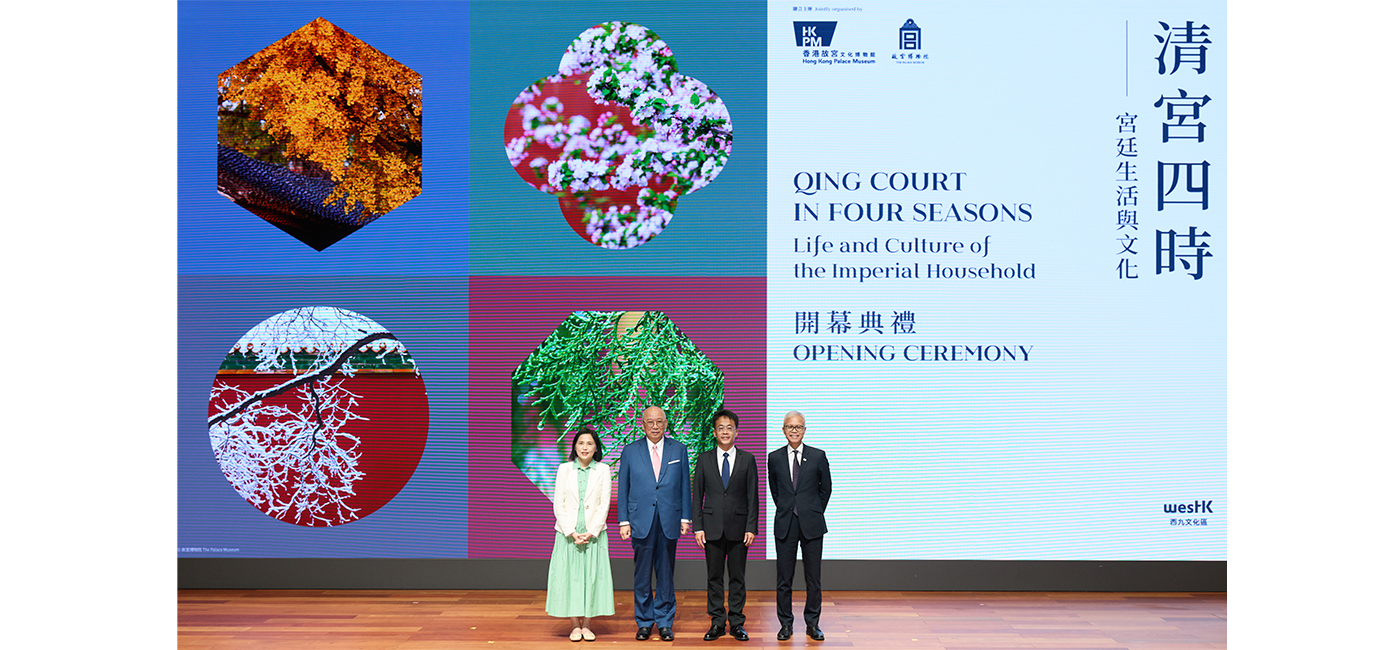
The Hong Kong Palace Museum (HKPM or the Museum) unveiled the new major thematic exhibition “Qing Court in Four Seasons: Life and Culture of the Imperial Household” (“Qing Court in Four Seasons”) today. Bringing 187 treasures from the Palace Museum, the exhibition invites visitors to trace the daily lives of the Qing (1644–1911) court through the changing seasons, exploring some important court activities within the year. These activities showcase the inheritance and development of traditional Chinese culture and heritage. This exhibition is jointly organised by the HKPM and the Palace Museum.
Opening to the public tomorrow (4 November), “Qing Court in Four Seasons” will be housed in Gallery 2, the Museum’s largest gallery. Previously, this gallery hosted the acclaimed opening exhibition “From Dawn to Dusk: Life and Art in the Forbidden City”, which provided visitors with a glimpse into a day inside the imperial palace. “Qing Court in Four Seasons” extends this timeline from a day to a year. To offer returning visitors new discoveries across different seasons, select exhibits will be rotated every three months.
Today’s opening ceremony at the HKPM was officiated by Leo Kung, Chairman of the HKPM Board; Wen Ming, Deputy Director of the Department of Court History of the Palace Museum; Betty Fung, Chief Executive Officer of the West Kowloon Cultural District Authority; and Dr Louis Ng, Museum Director of the HKPM.
Leo Kung, Chairman of the HKPM Board, said, “‘Qing Court in Four Seasons’ is the HKPM’s latest thematic exhibition dedicated to the culture and history of the Forbidden City. The curatorial team has brought a whole year of court activities to life within a 1,700-square-metre gallery through a curated selection of objects, inviting visitors to appreciate the enduring legacy and profound depth of Chinese culture. We warmly invite locals and travellers alike to experience this dedication and ingenuity, explore the rich and fascinating world of Qing court life, and gain a deeper understanding of the inheritance and development of China’s outstanding traditional culture.
A colourful journey through the seasons with the Qing court
The gallery design of “Qing Court in Four Seasons” is thoughtfully crafted, echoing the Complete Library of the Four Treasuries (Siku Quanshu), commissioned during the Qing dynasty, whose four main categories are colour-coded to match the four seasons: each exhibition section also adopts its own palette. With verdant green for spring, vermilion for summer, moon-white for autumn, and charcoal-grey for winter, visitors travel through the passage of time at the palace. At the beginning of spring, the court focused on the tradition of agriculture and sericulture and held ceremonies related to tilling and weaving. In summer, the court moved to the cooler Chengde Mountain Resort to escape the heat. Here, the emperor met with leaders of various tribes, a testament to the multicultural and inclusive nature of the Qing court. In autumn, the court relocated to the Mulan Hunting Grounds and turned its attention to the traditions of military training. In winter, the court’s Lunar New Year celebrations and festivities reflect heartfelt wishes for a prosperous and peaceful year ahead.
Here are some of the highlights of the exhibition:
- The introductory section, “Align with the Cycle of the Year”, showcases Qing-dynasty astronomical instruments. The featured armillary sphere, on view exclusively during the first six months of the exhibition, illustrates the court’s focus on astronomy and celestial movement. A calendar based on the observation of celestial phenomena was issued on the 1st day of the tenth lunar month each year, with a grand ceremony held at the Meridian Gate. The calendar governed daily life across Qing society.
- The section “Spring: Tilling and Weaving” centres on the Pictures of Tilling and Weaving, an album whose leaves will be shown in rotation throughout the exhibition; six leaves will be displayed at a time. In this precious album, Prince Yinzhen (the future Yongzheng Emperor, r. 1723–1735) and his consort are depicted as a working farmer and a silkworm breeder; the depiction is accompanied by poems personally inscribed by the prince to emphasise traditional society’s deep respect for agriculture and sericulture. Another highlight, vase with flowers of the twelve months, evokes the imperial court’s rituals during the Flower Festival in the second lunar month, when courtiers worshipped the flower deities to encourage agricultural and sericultural pursuits and pray for bountiful harvests. Furthermore, a rare painting, The Yongzheng Emperor Offering a Sacrifice at the Altar of Agriculture, will be on display starting from the first quarter of 2027.
- Summer in Beijing is sweltering. The section “Summer: Escaping the Heat” introduces that starting from the Kangxi period (1662–1722), Qing emperors normally stayed at the Chengde Mountain Resort between the fifth and the ninth lunar months. The resort was also known as the Resort for Escaping the Heat. Here, Qing emperors reviewed memorials, summoned ministers, handled military and political affairs, and had audiences with allied leaders, reflecting unity among ethnic groups. The right-spiralling conch displayed in this section was presented as a birthday gift to the Qianlong Emperor (r. 1736–1795) by the Sixth Panchen Lama, Lobsang Palden Yeshe (1738–1780). It was offered at the Chengde Mountain Resort to celebrate the emperorʼs 70th birthday. Another highlight is the 1.2-metre-tall clock with ducks and lotuses in a basin, masterfully crafted by the craftsmen of the Imperial Workshops by combining a Chinese cloisonné basin with a French musical mechanism. Designed to resemble lotus flowers in full summer bloom, the mechanical clock features opening petals that unfurl to reveal the scene of a child and an ape paying homage to the Queen Mother of the West (Xiwangmu) with a gift of peaches.
- A highlight of the section “Autumn: Hunting” is the vase with the “One Hundred Deer” pattern and bat-shaped handles. Deer patterns are considered auspicious, embodying longevity and prosperity. Their importance to the Qing court is reflected in the name of the Mulan Hunting Grounds, which in Manchu were literally “the site for deer hunting”. Complementing this hunting tradition is an antler armchair crafted from the antlers of deers hunted by the Kangxi Emperor. Also featured is a 2.5-metre-long tiger spear, a weapon unique to the Qing dynasty. It was specifically used by the Tiger-Hunting Brigade, a specialised unit of imperial guards that followed and protected the emperor during hunts.
- A highlight of the section “Winter: Celebrating the New Year” is a massive three-panel screen with scenes of Lunar New Year activities. Standing 3 metres tall and 3.6 metres long, the screen depicts the festive celebrations in the Qing court, including lantern dances, firecrackers, and the ritual burning of pine and cypress branches to dispel lingering misfortune. The section also presents ruyi sceptres and embroidered pouches filled with gold charm coins, all of which were common New Year gifts bestowed upon younger generations, officials, eunuchs, and maids during the festivities.
From visual splendour to tactile discovery
The exhibition features a number of multimedia and interactive installations designed to enrich and deepen visitor engagement. A highlight of the Summer section is an immersive installation, “From Beijing to Chengde”, created by acclaimed new media artist Jeffrey Shaw. Through a dynamic interplay of projections that shift from day to night, visitors will experience the passage of time and space as they accompany the emperor on his trip north from the Yuanming yuan in Beijing to the Chengde Mountain Resort. In the Winter section, an interactive calligraphy station “Imperial Calligraphy: Welcoming the Lunar New Year” allows visitors to try their hand at writing the character fu (blessings), and Lunar New Year auspicious inscriptions and couplets. The emperor wrote Lunar New Year calligraphy in the twelfth lunar month to usher in good fortune for the year ahead. By tracing his brushwork, visitors can experience the auspicious ritual for themselves.
Coinciding with the exhibition’s opening, the museum gift shop launches a new themed merchandise collection this November. Designed by the HKPM’s creative team, the series is titled “Imperial Cats: Endless Treasures in Four Seasons”, featuring a cast of new characters “Feline Emperor”, “Imperial Consort Cat”, “General Cat”, and “Black Cat Explorer”. Bringing history to life, highlights of the collection wittily reimagine iconic historical scenes, including the emperor praying for a bountiful harvest in The Yongzheng Emperor Offering a Sacrifice at the Altar of Agriculture. With a touch of modern humour, the collection also draws inspiration from the sericulture rite led by the empress, reimagining the imperial feline as diligent silkworm breeders from Pictures of Tilling and Weaving.
“Qing Court in Four Seasons: Life and Culture of the Imperial Household” will open to the public on 4 November 2026 in Gallery 2 of the HKPM. Visitors can access this exhibition with a General Admission ticket (Galleries 1 to 7; priced at HK$70 for adults and HK$35 for concessions*) or a Special Exhibition ticket. Tickets are available for sale or reservation via the HKPM website, the WestK website or mobile app, the WestK ticketing’s WeChat mini programme, and the online platforms of the Museum’s ticketing partners.
* Concessions are available to children aged 7 to 11, full-time students, seniors aged 60 and above, persons with disabilities (with one companion), and CSSA recipients. Children aged 6 and below do not need a ticket.
Remarks
About the Hong Kong Palace Museum
Through innovative curatorial approaches, the Hong Kong Palace Museum presents priceless treasures from the Palace Museum along with the finest collections from other world-renowned institutions. The Museum is also in the process of building its own world-class collection. Opened in 2022, the Museum is a leading institution for the study and appreciation of Chinese art and culture and the promotion of dialogue among world civilisations. The Museum is a collaborative project between the West Kowloon Cultural District Authority and the Palace Museum. The Hong Kong Jockey Club Charities Trust made a donation of HK$3.5 billion for its establishment, as well as some of the annual exhibitions and education programmes in 2023–2032.
Through research, exhibitions, publications, and educational and professional exchange programmes, the Museum builds international partnerships and positions Hong Kong as a global hub for art and culture. A resource that belongs to the local community, the Museum inspires community engagement, fosters dialogue, and promotes creativity and interdisciplinary collaboration.
About the Palace Museum
Established in 1925, the Palace Museum is a comprehensive museum built on the foundations of the Ming and Qing imperial palaces, the Forbidden City, integrating architecture, cultural relics, and the rich historical and cultural heritage of the imperial courts. In 1961, the State Council listed it as one of the first batch of “Major National Cultural Heritage Sites”, and in 1987, it was designated a World Heritage Site by UNESCO. The Palace Museum became a National 5A Tourist Attraction in 2007. The following year, it was among the first Chinese museums recognised by the National Cultural Heritage Administration as a “National First-level Museum”. The Palace Museum spans a total area of 106 hectares and has a total construction area of 233,300 square metres, making it the world’s largest and best-preserved historical palatial complex.
Today, the Palace Museum is an unparalleled art treasure house with a vast collection of over 1.95 million items/sets in twenty-five major categories. It showcases the time-honoured and splendid Chinese civilisation to the public through its imperial palace architecture; the display of original interior settings to illustrate the history of the imperial court; galleries dedicated to decorative arts, timepieces, paintings, calligraphic works, ceramics, and sculptures; and thematic exhibitions.
About the West Kowloon Cultural District (WestK)
WestK is one of the largest and most ambitious cultural hubs in the world and Hong Kong’s new cultural tourism landmark, spanning 40 hectares alongside Victoria Harbour. WestK comprises a mix of landmark arts and cultural facilities, including world-class museums M+ and the Hong Kong Palace Museum, intricately designed performing arts venues the Xiqu Centre and Freespace, the 11-hectare Art Park with a waterfront promenade, and the upcoming WestK Performing Arts Centre.
Hosting over 1,000 exhibitions, performances, programmes, and events each year, WestK provides a vital platform for both emerging and established artists. WestK welcomes more than 10 million visitors each year, evolving as the international cultural brand of Hong Kong and strengthening the city’s strategic role as an East-meets-West centre for international cultural exchange.
https://www.westk.hk/